This question asks you to explore a game of chance.
A game of chance involves attempting to win sweets from a basket through a series of rounds. The rules of the game are:
The player starts the game with at least one sweet.
At the start of each round the player spins a spinner.
If the spinner shows “win”, the player wins a sweet from the basket; otherwise, they must return one sweet to the basket.
The game is played until either all the sweets are won, or the player has no sweets remaining.
Initially, consider the case where there is a total of three sweets in the game.
Fiona starts the game with one sweet and there are two sweets in the basket to win.
The probability of obtaining a “win” in any round is $\displaystyle\frac{1}{4}$, independent of any other spin.
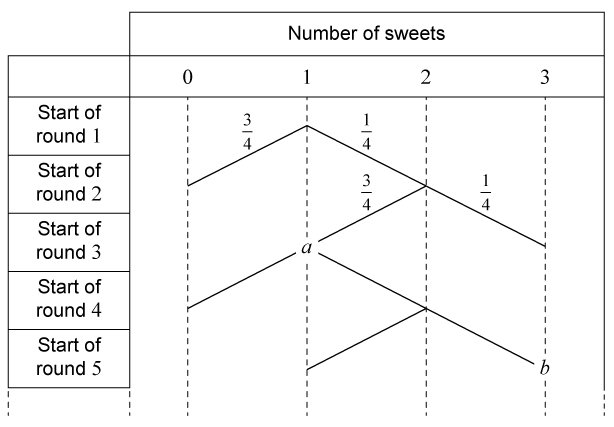
The following diagram shows the possible number of sweets that Fiona has at the start of each round, and the possible outcomes of the initial rounds.
If Fiona wins round $1$ she will have exactly two sweets at the start of round $2$.
If she loses round $1$, she will have no sweets remaining at the start of round $2$ and the game ends.
The probability of Fiona having exactly one sweet at the start of round $3$ is $a$, and the probability of her having three sweets at the start of round $5$ is $b$.
(a)(i)
Show that $a = \displaystyle\frac{3}{16}$.
[1]
(ii)
Find the value of $b$.
[2]
At the start of round $5$, Fiona has exactly one sweet.
(b)
Write down the probability that she will still have one sweet after two more rounds.
[2]
Now consider the case where there is a total of $w$ sweets in the game.
Let $R_n$ denote the probability that Fiona will eventually have all $w$ sweets, when she starts a round with $n$ sweets.
If Fiona finishes a round with no sweets, $n = 0$, the probability that she will eventually have all the sweets, $R_0$, is zero and the game ends.
For $n > 0$, if Fiona wins the next round, she will have $n + 1$ sweets and the probability of her eventually having all $w$ sweets is now $R_{n+1}$.
Similarly, if Fiona loses the next round, she will have $n - 1$ sweets and the probability of her eventually having all $w$ sweets is now $R_{n-1}$.
The probability that the spinner shows “win” is now $p$, where $0 < p < 1$, and the probability that it shows “not win” is $q$, where $q = 1 - p$ and $p \neq q$.
At the start of each round, $R_n$ is given by
$R_n = qR_{n-1} + pR_{n+1}\text{, where } n > 0.$
Consider the case where $w = 4$ and $p = \displaystyle\frac{1}{4}$.
(c)
Write down an expression for $R_2$ in terms of $R_1$ and $R_3$.
[1]
(d)
It is known that when Fiona starts a round with exactly one sweet, the probability that she will win the game is $R_1 = 0.025$. When she starts a round with exactly three sweets, the probability that she will win the game is $R_3 = 0.325$.
Find the value of $R_2$.
[2]
For the following parts of this question, consider the case where there is a total of $w$ sweets in the game and the probability that the spinner shows “win” is $p$.
(e)
By expressing $R_n$ as $(p + q)R_n$, show that $R_{n+1} - R_n = \displaystyle\frac{q}{p}(R_n - R_{n-1})$.
[2]
(f)(i)
Hence, find an expression for $R_2 - R_1$ in terms of $p$, $q$ and $R_1$.
[1]
(ii)
Show that $R_3 - R_2 = \left(\displaystyle\frac{q}{p}\right)^2 R_1$.
[2]
(iii)
Deduce an expression for $R_n - R_{n-1}$ in terms of $n$, $p$, $q$ and $R_1$.
Note: Award A1 for $1 – \left(\displaystyle\frac{q}{p}\right) + \left(\displaystyle\frac{q}{p}\right) – \left(\displaystyle\frac{q}{p}\right)^2$ and A1 for $+ \left(\displaystyle\frac{q}{p}\right)^{n-1} – \left(\displaystyle\frac{q}{p}\right)^n$.
Note: Condone use of equation or strict inequality up to this point.
$m = 109$
A1
[4 marks]
Total [26 marks]
Question 2
Calculator Not Allowed
Difficulty: Easy
[Maximum mark: 6]
A species of bird can nest in two seasons: Spring and Summer.
The probability of nesting in Spring is $k$.
The probability of nesting in Summer is $\frac{k}{2}$.
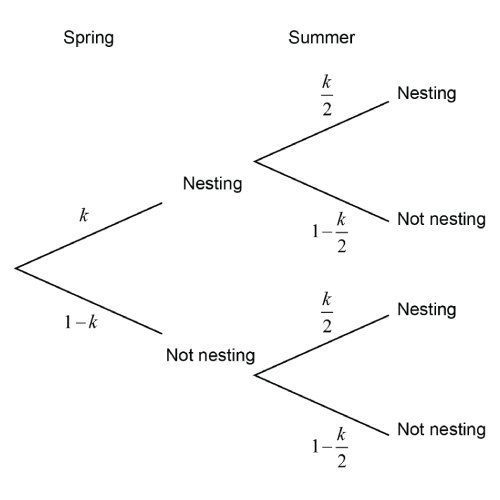
This is shown in the following tree diagram.
(a)Complete the tree diagram to show the probabilities of not nesting in each season. Write your answers in terms of $k$.
[2]
It is known that the probability of not nesting in Spring and not nesting in Summer is $\frac{5}{9}$.
(b)(i)Show that $9k^2 - 27k + 8 = 0$.
(ii)
Both $k = \frac{1}{3}$ and $k = \frac{8}{3}$ satisfy $9k^2 - 27k + 8 = 0$.
State why $k = \frac{1}{3}$ is the only valid solution.
[4]
Question Markscheme
Correct Answer:
(a)
$1 – k$ for Spring
A1
$1 – \frac{k}{2}$ for both Summers
A1
Question 3
Calculator Allowed
Difficulty: Easy
3.[Maximum mark: 6]
A supermarket analyses the shopping habits of its customers.
The number of times, $X$, each customer visits the supermarket in a week is given by the following probability distribution.
$x$
1
2
3
4
5
$\ge 6$
$\mathrm{P}(X = x)$
$1.5a$
$2a$
$0.281$
$a$
$0.026$
$0$
(a)
(i)Find the value of $a$.
(ii)Write down the mode of $X$.
[3]
(b)Find the mean of $X$.
[2]
The manager wants to know why customers come to their supermarket. They survey the first 50 customers to arrive at the supermarket on a particular day.
(c)Identify which one of the following best describes the manager's sampling method. Circle your answer.
[1]
Simple random / Systematic / Convenience / Quota / Stratified
$\mathrm{P}(A \cap B) = \dfrac{2}{3}\left(\dfrac{1}{4}\right)$
$= \dfrac{2}{12}\left(= \dfrac{1}{6}\right)$
A1
[3 marks]
(b)
attempt to use $\mathrm{P}(A \cup B) = \mathrm{P}(A) + \mathrm{P}(B) – \mathrm{P}(A \cap B)$ OR a Venn diagram, with their values of $\mathrm{P}(A)$ and $\mathrm{P}(B \cap A)$
$\mathrm{P}(B|A) = \mathrm{P}(B)\text{ OR }\mathrm{P}(A)\mathrm{P}(B) = \dfrac{1}{6}\text{ so }\mathrm{P}(A \cap B) = \mathrm{P}(A)\mathrm{P}(B)\text{ (hence }A\text{ and }B\text{ are independent)}$
R1
Note: The R1 is dependent on all previous marks
[3 marks]
Total [6 marks]
Question 5
Calculator Not Allowed
Difficulty: Easy
[Maximum mark: 9]
Consider two events, $A$ and $B$.
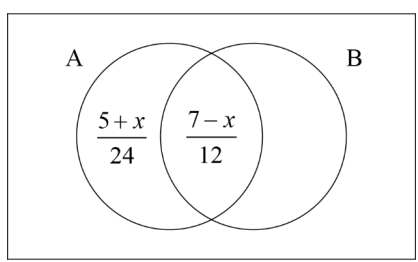
It is given that $\mathrm{P}(A \cap B') = \dfrac{5 + x}{24}$, $\mathrm{P}(A \cap B) = \dfrac{7 - x}{12}$ and $\mathrm{P}(A' \cap B) = \dfrac{1}{6}$, where $0 \le x \le 7$.
(a)
Show that $\mathrm{P}(A) = \dfrac{19 - x}{24}$.[3]
It is given that $A$ and $B$ are independent.
(b)
Find the possible values of $x$.[6]
Question Markscheme
Correct Answer:
(a) attempt to draw Venn diagram or attempt to use $\mathrm{P}(A) = \mathrm{P}(A \cap B’) + \mathrm{P}(A \cap B)$
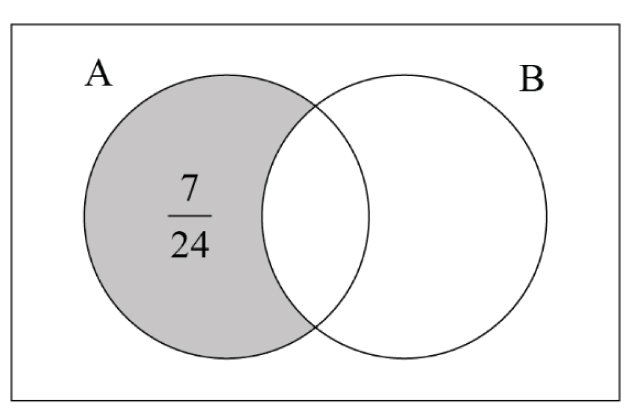
$\mathrm{P}(A’ \mid B) = \dfrac{27}{48}\left(= \dfrac{9}{16}\right)$
A1
[4 marks]
Total [7 marks]
Question 8
Calculator Allowed
Difficulty: Medium
11.[Maximum mark: 18]
Amanda enters data from surveys into a database. It can be assumed that the accuracy of any survey entered is independent of all other surveys entered.
From previous records, it is known that Amanda enters $8\%$ of the surveys inaccurately.
(a)On a particular day Amanda enters data from $50$ surveys.
(i)Find the probability that Amanda entered at most six surveys inaccurately.
(ii)Given that at most six surveys were entered inaccurately, find the probability that exactly four surveys were entered inaccurately.
[5]
On a different day Amanda enters data from $n$ surveys. On this day, the probability that at most six surveys were entered inaccurately is approximately $0.367$.
(b)Find the value of $n$.
[3]
Bryce and Carmen also enter data from surveys into the same database. It is known that surveys entered by Bryce and Carmen are inaccurate $6\%$ and $11\%$ of the time respectively. It can again be assumed that the accuracy of any survey entered is independent of all other surveys entered.
From the surveys assigned to the three of them, Amanda enters $55\%$, Bryce $25\%$ and Carmen $20\%$.
(c)Find the probability that a randomly selected survey was
(i)entered inaccurately;
(ii)entered by Amanda, given that the survey was entered inaccurately.
[6]
The following year, the accuracy of Amanda’s and Bryce’s work remained the same, as did the percentage of surveys entered by each of the three employees. However, Carmen’s accuracy had improved and the probability that she entered a survey inaccurately was now $x\%$.
The probability that a randomly selected survey had been entered inaccurately was now the same as the probability that Carmen made an error when entering a survey.
(d)Find the value of $x$.
[4]
Question Markscheme
Correct Answer:
11.
(a) (i) recognizing binomial distribution
(M1)
$E \sim \mathrm{B}(50,\, 0.08)$ , where $E$ is the number of inaccurate surveys