Questions in Distributions (25)

Question 1
Calculator Not Allowed
Difficulty: Easy

[Maximum mark: 6]
A continuous random variable $X$ has a probability density function $f$ given by
$$f(x) = \begin{cases} kx & 0 \le x \le k \\ 2kx - x^2 & k < x \le 2k \\ 0, & \text{otherwise} \end{cases}$$
where $k > 0$.
(a) Show that $k$ satisfies the equation $7k^3 = 6$.
[2]
(b) Find the median of $X$.
[4]

Question 2
Calculator Allowed
Difficulty: Easy

[Maximum mark: 5]
A continuous random variable $X$ has a probability density function given by
$\displaystyle f(x) = \begin{cases} \dfrac{1 - \cos 2x}{a}, & 0 \le x \le \pi \\ 0, & \text{otherwise} \end{cases} \quad \text{where } a > 0.$
(a) Find the exact value of $a$.
[2]
(b) Find $\operatorname{Var}(X)$.
[3]

Question 3
Calculator Allowed
Difficulty: Easy

[Maximum mark: 8]
A continuous random variable $X$ has probability density function
$$f(x) = \begin{cases} \dfrac{1}{5} & 0 \le x < 2 \\[10pt] -\dfrac{x}{30} + \dfrac{4}{15} & 2 \le x \le 8 \\[10pt] 0 & \text{otherwise.} \end{cases}$$
(a) Find $\text{E}(X)$.
[3]
(b) Given that $\text{E}(c - 2X) = 0$, where $c$ is a constant, determine the value of $c$.
[2]
(c) Find the median of $X$.
[3]

Question 4
Calculator Allowed
Difficulty: Easy

[Maximum mark: 5]
A discrete random variable, $X$, has the following probability distribution:
$$\text{P}(X = x) = \dfrac{kx}{20} \text{ for } x \in \{3, 5, 8, 11\}.$$
(a) Find the value of $k$.
[2]
(b) Find $\text{E}(X)$.
[3]

Question 5
Calculator Not Allowed
Difficulty: Easy

[Maximum mark: 5]
A farmer grows two types of apples—cooking apples and eating apples. The weights of the apples, in grams, can be modelled as normal distributions with the following parameters.
Apple type Mean $\mu$ Standard deviation $\sigma$
Eating $100\text{ g}$ $20\text{ g}$
Cooking $140\text{ g}$ $40\text{ g}$
For each type of apple you can assume that $95\%$ of the weights are within two standard deviations of the mean.
(a) Find the percentage of eating apples that have a weight greater than $140\text{ g}$.
[1]
The farmer grows a large number of apples of which $80\%$ are eating apples.
Both types of apples are picked and randomly mixed together in a cleaning machine.
After cleaning, the machine separates out those that have a weight greater than $140\text{ g}$ into a container.
(b) An apple is randomly selected from this container. Find the probability that it is an eating apple. Give your answer in the form $\frac{c}{d}$, where $c, d \in \mathbb{Z}^+$.
[4]

Question 6
Calculator Not Allowed
Difficulty: Easy

[Maximum mark: 7][cite: 41]
A garden centre sells seeds for two varieties of sunflowers: large and giant.[cite: 41]
The heights of large sunflowers are normally distributed with mean $\mu$ and standard deviation $\sigma$.[cite: 41]
It is known that $25\%$ of large sunflowers have a height of over $180\,\text{cm}$.[cite: 41]
(a) Given that $\mu + A\sigma = 180$, where $A \in \mathbb{R}$, find the value of $A$.[cite: 41]
[3][cite: 41]
The heights of giant sunflowers are also normally distributed.[cite: 41]
The giant sunflowers have a mean height that is $35\,\text{cm}$ more than that of the large sunflowers and a standard deviation that is double that of the large sunflowers.[cite: 41]
It is known that $98\%$ of giant sunflowers have a height greater than $180\,\text{cm}$.[cite: 41]
(b) Determine $\mu$ and $\sigma$.[cite: 41]
[4][cite: 41]

Question 7
Calculator Allowed
Difficulty: Easy

[Maximum mark: 7]
A large group of adults have their heights measured. The heights of the adults are normally distributed with mean $\mu\,\text{cm}$ and standard deviation $\sigma\,\text{cm}$.
The probability that one of the adults chosen at random has a height greater than $171\,\text{cm}$ is $0.4$.
If one of the adults with a height greater than $171\,\text{cm}$ is chosen at random, the probability that their height is greater than $175\,\text{cm}$ is $0.35$.
Find the value of $\mu$ and the value of $\sigma$.
[7]

Question 8
Calculator Not Allowed
Difficulty: Medium

[Maximum mark: 15]
A shop sells chocolates. The weight, in kilograms, of chocolates bought by a random customer can be modelled by a continuous random variable $X$ with probability density function $f$ defined by
$$f(x) = \begin{cases} \dfrac{6}{85}(4 + 3x - x^2), & 0.5 \le x \le 3 \\ 0, & \text{otherwise} \end{cases}.$$
(a) Find the mode of $X$.
[2]
(b) Find $\text{P}(1 \le X \le 2)$.
[2]
(c) Find the median of $X$.
[3]
The shop sells chocolates to customers at $\$25$ per kilogram.
However, if the weight of chocolate bought by a customer is at least $0.75$ kilograms, the shop sells chocolate at a discounted rate of $\$24$ per kilogram.
(d) Find the probability that a randomly selected customer spends at most $\$48$.
[3]
(e) Find the expected amount spent per customer. Give your answer correct to the nearest cent.
[5]

Question 9
Calculator Not Allowed
Difficulty: Medium

Answer all questions in the answer booklet provided. Please start each question on a new page.
[Maximum mark: 17]
At Adam's Apple Orchard the weights of apples, $W$, in grams, are normally distributed with a mean $175\text{ grams}$ and standard deviation $8\text{ grams}$.
(a) Find the probability that a randomly chosen apple weighs less than $170\text{ grams}$.
[2]
(b) It is found that $20\%$ of the apples weigh more than $w\text{ grams}$. Find $w$, correct to four significant figures.
[2]
All orchards classify an apple as premium when its weight is between $170$ and $185\text{ grams}$.
(c) Find the percentage of apples that are classified as premium at Adam's Apple Orchard.
[2]
After orders are completed, there are many apples left over. Boxes are filled with randomly chosen left-over apples. Each box contains $40$ apples.
(d) Find the probability that a randomly chosen box contains at least $30$ premium apples.
[3]
(e) If $10$ of these boxes are randomly selected, find the probability that exactly $4$ boxes have at least $30$ premium apples.
[2]
At a neighbouring orchard the weights of apples, $M$, in grams, are normally distributed with mean $\mu$ and standard deviation $\sigma$. It is known that:
•  $82\%$ of their apples are classified as premium
•  the percentage of apples that weigh less than $170\text{ grams}$ is twice the percentage of apples that weigh more than $185\text{ grams}$.
(f) Find the value of $\mu$.
[6]

Question 10
Calculator Allowed
Difficulty: Easy

[Maximum mark: 6]
Consider a binomial random variable, $X$, such that $X \sim \text{B}(15,\, p)$, where $p \neq 0$.
The mean of the distribution is three times as large as the standard deviation.
(a) Find $p$.
[3]
(b) Find $\text{P}(X = 9 \mid X > 6)$.
[3]

Question 11
Calculator Not Allowed
Difficulty: Easy

[Maximum mark: 5]
Consider a random variable $X$ such that $X \sim \text{B}(n, 0.25)$.
Determine the least value of $n$ such that $\text{P}(X \ge 1) > 0.99$.

Question 12
Calculator Not Allowed
Difficulty: Easy

[Maximum mark: 5]
Consider the following grouped data set.
Class Frequency
$15 < y \le 20$ $31$
$20 < y \le 25$ $42$
$25 < y \le 30$ $61$
$30 < y \le 35$ $46$
$35 < y \le 40$ $29$
(a) Find an estimate for
(i) the mean;
(ii) the standard deviation.
[2]
The data can be approximated by a normal distribution.
(b) Use this information and your mean and standard deviation found in part (a) to find an approximate value for the interquartile range correct to two significant figures.
[3]

Question 13
Calculator Not Allowed
Difficulty: Medium

[Maximum mark: 19]
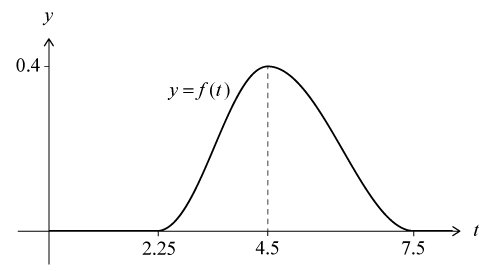
In a marathon race, the random variable $T$ represents the time, in hours, taken for a runner to complete the race. No runner completes the race in less than $2.25$ hours, and no runner completes it in more than $7.5$ hours.
The probability density function for $T$ is modelled by $f$, defined by
$$f(t) = \begin{cases} \dfrac{4}{21}\left(1 - \cos\left(\dfrac{4\pi}{9}(t - 2.25)\right)\right), & 2.25 \le t < 4.5 \\[12pt] \dfrac{4}{21}\left(1 + \cos\left(\dfrac{\pi}{3}(t - 4.5)\right)\right), & 4.5 \le t \le 7.5 \\[10pt] 0, & \text{otherwise.} \end{cases}$$
The graph of $f$ has a maximum point at $t = 4.5$ as shown in the following diagram:
Graph of probability density function y = f(t)
(a) (i) Find the value of $\displaystyle\int_{2.25}^{4.5} f(t)\,\mathrm{d}t$.
(ii) Write down the mode of $T$.
(iii) Determine which is greater, the mode of $T$ or the median of $T$, justifying your answer.
[4]
The runners who finish the race in $3.5$ hours or less are considered to be fast runners.
(b) Find the probability that a runner chosen at random is a fast runner.
[2]
(c) Find the probability that a fast runner chosen at random finishes the race in $3$ hours or less.
[3]
(d) Find the lower quartile of $T$.
[3]
Each runner's time is converted to a score which is calculated as $a - bt$, where $t$ represents their time in hours, and $a, b > 0$. Consider the random variable $P$ which represents the score of a runner. It is given that $\mathrm{E}(P) = 100$ and the maximum possible score is $150$.
(e) Use $\mathrm{E}(T) = 4.723$ to determine the value of $a$ and the value of $b$, giving your answers to the nearest integer.
[5]
(f) Given also that $\mathrm{Var}(T) = 0.906$, find $\mathrm{Var}(P)$.
[2]

Question 14
Calculator Not Allowed
Difficulty: Easy

[Maximum mark: 6]
In Happyland, the weather on any given day is independent of the weather on any other day. On any day in May, the probability of rain is $0.2$. May has $31$ days.
Find the probability that
(a) it rains on exactly $10$ days in May;
[2]
(b) it rains on at least $10$ days in May;
[2]
(c) the first day that it rains in May is on the $10\text{th}$ day.
[2]

Question 15
Calculator Not Allowed
Difficulty: Easy

[Maximum mark: 6]
On a Monday at an amusement park, a sample of $40$ visitors was randomly selected as they were leaving the park. They were asked how many times that day they had been on a ride called The Dragon. This information is summarized in the following frequency table.
Number of times on
The Dragon
Frequency
$0$ $6$
$1$ $16$
$2$ $13$
$3$ $2$
$4$ $3$
It can be assumed that this sample is representative of all visitors to the park for the following day.
(a) For the following day, Tuesday, estimate
(i) the probability that a randomly selected visitor will ride The Dragon;
(ii) the expected number of times a visitor will ride The Dragon.
[4]
It is known that $1000$ visitors will attend the amusement park on Tuesday. The Dragon can carry a maximum of $10$ people each time it runs.
(b) Estimate the minimum number of times The Dragon must run to satisfy demand.
[2]

Question 16
Calculator Allowed
Difficulty: Easy

[Maximum mark: 7]
The continuous random variable $X$ has a probability density function $f$, given by
$\displaystyle f(x) = \begin{cases} \dfrac{3}{4}x^2(2-x) & 0 \le x \le 2 \\ 0 & \text{otherwise.} \end{cases}$
(a) Find $\text{P}(0.5 \le X < 1.5)$.
[2]
The discrete random variable $Y$ is defined as the continuous random variable $X$ rounded to the nearest integer. Hence, $Y$ can only take the value $0$, $1$ or $2$.
The probability distribution for $Y$ is given in the following table.
y 0 1 2
$\text{P}(Y = y)$ a b c
(b)
(i) Write down the value of $b$.
(ii) Find the value of $a$ and the value of $c$.
[3]
(c) Find $\text{E}(Y)$.
[2]

Question 17
Calculator Allowed
Difficulty: Easy

[Maximum mark: 6]
The continuous random variable $X$ has a probability distribution $f$ defined as
$f(x) = \begin{cases} \dfrac{b}{a}x, & 0 \le x \le a \\ \dfrac{b}{a - 5}(x - 5), & a < x \le 5 \end{cases} \quad \text{where } 0 < a < 5 \text{ and } b \in \mathbb{Q}^+.$
The graph of $f$ is shown in the following diagram.
Probability distribution graph of f(x)
(a) Show that $b = 0.4\,.$
[2]
It is given that $\text{E}(X) = 3.2\,.$
(b) Find the value of $a\,.$
[4]

Question 18
Calculator Not Allowed
Difficulty: Easy

[Maximum mark: 8]
The discrete random variable $X$ has the following probability distribution:
$x$ $1$ $2$ $3$
$\mathrm{P}(X = x)$ $0.6 - 2a$ $3a$ $0.4 - a$
(a) Find the range of possible values of $a$.
[2]
(b) In the case where $a = 0.2$, determine $\operatorname{Var}(2 - X)$.
[6]

Question 19
Calculator Not Allowed
Difficulty: Easy

[Maximum mark: 4]
The random variable $X$ is normally distributed with mean $10$ and standard deviation $2$.
(a) Find the probability that $X$ is more than $1.5$ standard deviations above the mean.
[2]
The probability that $X$ is more than $k$ standard deviations above the mean is $0.1$, where $k \in \mathbb{R}$.
(b) Find the value of $k$.
[2]

Question 20
Calculator Not Allowed
Difficulty: Easy

[Maximum mark: 6]
The random variables $X$ and $Y$ are normally distributed with $X \sim \mathrm{N}(7,\, a^2)$ and $Y \sim \mathrm{N}(19,\, a^2)$, where $a > 0$.
(a) Find $b$ such that $\mathrm{P}(X > b) = \mathrm{P}(Y > 22)$.
[2]
(b) Write down the approximate value of $\mathrm{P}(7 - a < X < 7 + a)$, correct to two significant figures.
[1]
(c) Given that $a = 3$, calculate the approximate value of $\mathrm{P}(Y < 22)$, correct to two significant figures.
[3]

Question 21
Calculator Allowed
Difficulty: Medium

[Maximum mark: 18]
The waiting time, $T\text{ minutes}$, of patients at a clinic can be modelled by a normal distribution with mean $\mu$ and standard deviation $\sigma$. The waiting times of all patients are independent of each other.
$3.8\%$ of the patients have a waiting time of less than $20\text{ minutes}$, while $7.3\%$ of the patients have a waiting time of more than $30\text{ minutes}$.
(a)
(i) Find the value of $\mu$ and the value of $\sigma$.
(ii) Hence, find the probability that a patient chosen at random has a waiting time of between $15$ and $22\text{ minutes}$.
[7]
The doctor at the clinic only sees patients with an appointment.
Records show that $82.6\%$ of patients attend their appointment.
The probability of a patient attending their appointment is independent of any other patient.
(b) On a particular day, $20\text{ patients}$ each made an appointment to see the doctor.
(i) Find the probability that at least $13$ of these patients attended their appointment.
(ii) Given that at least $13$ of these patients attended their appointment, find the probability that more than $2\text{ patients}$ did not attend their appointment.
[7]
On any day, the doctor can see a maximum of $40\text{ patients}$.
Some patients do not attend their appointments. The clinic decides to allow more than $40\text{ appointments}$ to be made each day.
The clinic aims for a probability of at least $99\%$ that the doctor sees all the patients who arrive for their appointment.
(c) Find the greatest number of appointments that can be made to achieve the clinic’s aim.
[4]

Question 22
Calculator Allowed
Difficulty: Medium

[Maximum mark: 15]
The weights of red potatoes are normally distributed with mean $173\text{ grams}$ and standard deviation $21\text{ grams}$.
(a) Find the probability that a randomly selected red potato weighs
(i) less than $180\text{ grams}$;
(ii) between $180\text{ grams}$ and $200\text{ grams}$;
(iii) between $180\text{ grams}$ and $200\text{ grams}$ given it weighs more than $180\text{ grams}$.
[6]
The weights of purple potatoes are normally distributed with mean $\mu\text{ grams}$ and standard deviation $\sigma\text{ grams}$.
The probability that a purple potato weighs less than $170\text{ grams}$ is $0.62102$.
The probability that a purple potato weighs between $170\text{ grams}$ and $180\text{ grams}$ is $0.23799$.
(b) Find the mean, $\mu$, and standard deviation, $\sigma$, of purple potatoes.
[6]
Joli has one bag of red potatoes and one bag of purple potatoes.
Joli randomly selects one potato from each bag.
(c) Find the probability that at least one of these potatoes weighs more than $180\text{ grams}$.
[3]

Question 23
Calculator Allowed
Difficulty: Hard

[Maximum mark: 23]
This question asks you to use polynomial functions to model some situations in probability.
Two unbiased tetrahedral (four-sided) dice with faces labelled $1, 2, 3$ and $4$ are thrown and the scores recorded.
The random variable $M$ denotes the maximum of these two scores.
The probability distribution of $M$ is given in the following table.
m 1 2 3 4
$\mathrm{P}(M = m)$ $\dfrac{1}{16}$ $\dfrac{3}{16}$ $\dfrac{5}{16}$ $\dfrac{7}{16}$
(a)
Find $\mathrm{E}(M)$. [2]
An alternative way to represent the probability distribution of $M$ is to use a polynomial function, $G$, where $G(t) = \displaystyle\sum_{m=1}^{4} \mathrm{P}(M = m)t^m$.
Hence, for the distribution of $M$, $G(t) = \dfrac{1}{16}t + \dfrac{3}{16}t^2 + \dfrac{5}{16}t^3 + \dfrac{7}{16}t^4$.
(b)
Find $G(1)$. [1]
(c)
(i)
Find $G'(t)$. [2]
(ii)
Hence, show that $G'(1) = \mathrm{E}(M)$. [3]
A bag contains two red balls and three yellow balls.
Two balls are selected at random without replacement from the bag.
The random variable $X$ denotes the total number of red balls selected.
The probability distribution of $X$ can be represented by the polynomial function, $G_X$, where
$G_X(t) = \displaystyle\sum_{x=0}^{2} \mathrm{P}(X = x)t^x$.
(d)
Show that $G_X(t) = \dfrac{3}{10} + \dfrac{3}{5}t + \dfrac{1}{10}t^2$, making it clear how the coefficients of $G_X(t)$ have been determined. [5]
An unbiased coin and a biased coin are tossed.
The probability of obtaining a tail on the biased coin is $p$.
The random variable $Y$ denotes the total number of tails obtained from tossing both coins.
The probability distribution of $Y$ can be represented by the polynomial function, $G_Y$, where
$G_Y(t) = \displaystyle\sum_{y=0}^{2} \mathrm{P}(Y = y)t^y$.
(e)
Given that the coefficient of $t^2$ in $G_Y(t)$ is $\dfrac{1}{3}$, find
(i)
the value of $p$; [2]
(ii)
an expression for $G_Y(t)$. [4]
The random variable $Z$ denotes the sum of the total number of red balls selected, $X$, and the total number of tails obtained from tossing both coins, $Y$.
The probability distribution of $Z$ can be represented by the function, $G_Z$, where
$G_Z(t) = G_X(t)G_Y(t)$.
(f)
For random variable $Z$, it can be shown that $G_Z'(1) = \mathrm{E}(Z)$.
Use this result to find $\mathrm{E}(Z)$. [4]

Question 24
Calculator Allowed
Difficulty: Hard

[Maximum mark: 27]
This question considers two possible models for the occurrence of random events in a computer game.
In a new computer game, each time a player performs an action, there is a random chance that the action will be boosted, meaning that it provides a benefit to the player.
The designer of this computer game is considering two possible models for when to boost an action.
In the first model, the probability that an action will be boosted is constant.
(a) Suppose the probability that an action will be boosted is $0.1$.
(i) Find the probability that the first boost occurs on the third action.
[2]
(ii) Find the probability that at least one boost occurs in the first six actions.
[3]
(b) Suppose the probability that an action will be boosted is $p$, where $0 < p < 1$.
(i) Explain why the probability that the first boost occurs on the $x^{\text{th}}$ action is $p(1 - p)^{x-1}$.
[1]
Let $X$ be the number of actions until the first boost occurs.
(ii) Hence, write down an expression, using sigma notation, for $\text{E}(X)$ in terms of $x$ and $p$.
[1]
Consider the sum of an infinite geometric sequence, with first term $a$ and common ratio $r \ (|r| < 1)$,
$$a + ar + ar^2 + ar^3 + \dots = \dfrac{a}{1 - r}.$$
(c) (i) By differentiating both sides of the above equation with respect to $r$, find an expression for $\displaystyle\sum_{n=1}^{\infty} n a r^{n-1}$ in terms of $a$ and $r$.
[4]
(ii) Hence, show that $\text{E}(X) = \dfrac{1}{p}$.
[2]
It can be shown that $\text{Var}(X) = \dfrac{1 - p}{p^2}$.
(d) Find $\text{E}(X)$ and $\text{Var}(X)$ when $p = 0.1$.
[2]
In the designer's second model, the initial probability that an action is boosted is $0.2$, and each time an action occurs that is not boosted, the probability that the next action is boosted increases by $0.2$. After an action has been boosted, the probability resets to $0.2$ for the next action.
(e) Show that the probability that the first boost occurs on the third action is $0.288$.
[2]
Let $Y$ be the number of actions until the first boost occurs.
(f) Explain why $Y \le 5$.
[1]
The following table shows the probability distribution of $Y$.
$y$ $1$ $2$ $3$ $4$ $5$
$\text{P}(Y = y)$ $0.2$ $m$ $0.288$ $n$ $0.0384$
(g) (i) Find the value of $m$ and the value of $n$.
[2]
(ii) Show that $\text{E}(Y) = 2.5104$.
[2]
(iii) Find $\text{Var}(Y)$.
[2]
(h) (i) Use the expression given in (c)(ii) to find the value of $p$ for which $\text{E}(X) = \text{E}(Y)$.
[1]
(ii) Find $\text{Var}(X)$ for this value of $p$.
[1]
(iii) Hence determine, with a reason, which model provides a more consistent experience for the player with respect to boosted actions.
[1]

Question 25
Calculator Not Allowed
Difficulty: Easy

[Maximum mark: 7]
Two machines are used in a factory to manufacture semiconductors. Machine A manufactures defective semiconductors $10\%$ of the time, while machine B manufactures defective semiconductors $5\%$ of the time.
A randomly selected machine manufactures ten semiconductors.
Both machines are equally likely to be selected.
(a) Find the probability that exactly two semiconductors are defective.
[4]
(b)
Given that exactly two semiconductors are defective, find the probability that they were
manufactured by machine A.
[3]