Questions in Sequence (20)

Question 1
Calculator Allowed
Difficulty: hard

[Maximum mark: 27]
This question asks you to investigate models for the population of trout in a lake.
Trout is a type of fish. At the start of a year, a lake is estimated to contain $6000$ trout.
The owner of the lake estimates that the number of trout will increase by $10\%$ per year.
At the end of each year, the owner proposes to remove $500$ trout from the lake to prevent overpopulation.
Therefore, the relationship between $T_n$, the predicted number of trout at the start of year $n$, and $T_{n+1}$, the predicted number of trout at the start of year $n + 1$, is given by
$T_{n+1} = 1.1T_n - 500$ and $T_1 = 6000$.
For example, the predicted number of trout at the start of the second year is given by
$T_2 = 1.1T_1 - 500$.
(a) Use this formula to verify that $T_2 = 6100$.
[2]
(b) (i) Verify that $T_3 = 6210$.
[1]
(ii) Find $T_4$.
[2]
It is also known that $T_n = 6000(1.1)^{n-1} - \dfrac{500\big((1.1)^{n-1} - 1\big)}{1.1 - 1}$.
(c) (i) Show that $T_n = 1000(1.1)^{n-1} + 5000$.
[2]
(ii) Hence, or otherwise, find $T_6$. Give your answer to the nearest whole number.
[2]
After deciding that the trout population would increase too quickly, the lake owner proposes instead to remove $750$ trout at the end of each year.
The relationship between $D_n$, the predicted number of trout at the start of year $n$, and $D_{n+1}$, the predicted number of trout at the start of year $n + 1$, is now given by
$D_{n+1} = 1.1D_n - 750$ and $D_1 = 6000$.
It is also known that $D_n = -1500(1.1)^{n-1} + 7500$.
(d) (i) Show that $D_{n+1} - D_n = -150(1.1)^{n-1}$.
[3]
(ii) Use the result in part (d)(i) to deduce that the predicted number of trout at the start of any year will be greater than the predicted number at the start of the next year.
[1]
(e) Determine the first year during which there will be no trout remaining in the lake.
[4]
The lake owner now considers a more general approach where $d$ trout are removed at the end of each year.
Let $C_n$ denote the predicted number of trout in the lake at the start of the $n\text{th}$ year where
$C_n = 6000(1.1)^{n-1} - 10d\big((1.1)^{n-1} - 1\big)$.
(f) Find the value of $d$ such that the predicted number of trout at the start of each year is constant.
[3]
To model predicted numbers of trout, the lake owner has been using sequences generated by
$u_{n+1} = ru_n - d$, where $d, r \in \mathbb{R}^+$ and $r \ne 1$.
(g) Use mathematical induction to prove that $u_n = u_1 r^{n-1} - \dfrac{d\left(r^{n-1} - 1\right)}{r - 1}$, for $n \in \mathbb{Z}^+$.
[7]

Question 2
Calculator Not Allowed
Difficulty: Easy

[Maximum mark: 7]
A geometric sequence has first term $80$ and fourth term $0.74088$.
(a) Find the second term.
[3]
The first two terms of this geometric sequence are also the first term and eleventh term respectively, of an arithmetic sequence.
Let $S_n$ denote the sum of the first $n$ terms of the arithmetic sequence.
(b) Find the greatest value of $S_n$, giving your answer to two decimal places.
[4]

Question 3
Calculator Not Allowed
Difficulty: Easy

[Maximum mark: 6]
Alex purchases a car for €$30\,000$. The value of the car depreciates at $15\%$ per annum.
(a) Find the value of the car after ten years. Give your answer to two decimal places.
[2]
Alex invests €$50\,000$ in a bank account that pays a compound interest rate of $1.5\%$ per month.
Inflation over the same time period was $0.8\%$ per month.
(b) Find the number of months required for the real value of the investment to first exceed €$55\,000$.
[4]

Question 4
Calculator Allowed
Difficulty: Medium

[Maximum mark: 13]
At the start of $2026$, Lavinia receives a gift of $\$15\,000$. She wants to buy a boat which costs $\$28\,000$ so she decides to invest her money.
On 1 January $2026$ Lavinia invests her money in a bank account which pays interest at a nominal annual rate of $4.8\%$, compounded quarterly. The interest is paid into her account on the last day of each quarter. She makes no further deposits to, or withdrawals from, the account.
(a)
Find the amount of money Lavinia will have in her bank account on 1 January $2031$.
Give your answer correct to the nearest dollar.
[3]
(b) Show that Lavinia will first have more than $\$28\,000$ in her bank account during the year $2039$.
[3]
The cost of the boat at the start of $2026$ was $\$28\,000$, and it depreciates at a constant annual rate of $r\%$. After one year the cost of the boat is $\$26\,222$.
(c) Find the value of $r$.
[2]
Due to this depreciation, Lavinia will be able to buy the boat before $2039$. She will buy the boat as soon as she has enough money in her bank account to pay for it.
(d) Determine the year during which Lavinia will buy the boat.
[5]

Question 5
Calculator Not Allowed
Difficulty: Easy

[Maximum mark: 5]
Consider a geometric sequence with first term $1$ and common ratio $10$.
$S_n$ is the sum of the first $n$ terms of the sequence.
(a) Find an expression for $S_n$ in the form $\frac{a^n - 1}{b}$, where $a, b \in \mathbb{Z}^+$.
[1]
(b) Hence, show that $S_1 + S_2 + S_3 + \dots + S_n = \frac{10(10^n - 1) - 9n}{81}$.
[4]

Question 6
Calculator Not Allowed
Difficulty: EASY

[Maximum mark: 5]
Consider a geometric sequence with first term $1$ and common ratio $10$.
$S_n$ is the sum of the first $n$ terms of the sequence.
(a) Find an expression for $S_n$ in the form $\displaystyle\frac{a^n - 1}{b}$, where $a, b \in \mathbb{Z}^+$.
[1]
(b) Hence, show that $S_1 + S_2 + S_3 + \ldots + S_n = \displaystyle\frac{10(10^n - 1) - 9n}{81}$.
[4]

Question 7
Calculator Not Allowed
Difficulty: Easy

[Maximum mark: 6]

Consider a geometric sequence, $u_n$, with common ratio $r$, where each term in the sequence is positive.

It is given that $u_6 = 1.6 \times 10^5$ and $u_8 = 6.4 \times 10^5$.

(a)
Find the value of $r$. [3]
(b)
Find the value of $u_1$, giving your answer in the form $a \times 10^k$, where $1 \le a < 10$ and $k \in \mathbb{Z}$. [3]

Question 8
Calculator Not Allowed
Difficulty: Easy

[Maximum mark: 8]
Consider a sequence of ten rectangular picture frames $F_1, F_2, \ldots, F_9, F_{10}$.
Picture frame $F_1$ has width $4\text{ cm}$ and height $5\text{ cm}$.
The width and height of picture frame $F_n$ are each increased by $50\%$ to generate the width and height of the next picture frame $F_{n+1}$, for $n \in \mathbb{Z}^+,\ 1 \le n \le 9$.
(a)(i)Show that the area of picture frame $F_n$ is $20\left(\dfrac{9}{4}\right)^{n-1}\text{cm}^2$.
(ii)Hence, find the mean area of the ten picture frames, giving your answer in the form $p\left(\left(\dfrac{9}{4}\right)^a - 1\right)\text{cm}^2$, where $p \in \mathbb{Q}^+,\ a \in \mathbb{Z}^+$.
[5]
(b)Find the median area of the ten picture frames, giving your answer in the form $q\left(\dfrac{9}{4}\right)^4\text{cm}^2$, where $q \in \mathbb{Q}^+$.
[3]

Question 9
Calculator Not Allowed
Difficulty: Easy

[Maximum mark: 6]
Consider an infinite convergent geometric sequence, with first three terms $u_1\text{, } u_2\text{, } u_3$.
The sum of the first $k$ terms of this sequence is equal to half of the sum of the infinite geometric sequence.
It is given that $u_{k+1} = \displaystyle\frac{1}{16}$.
(a) Show that $u_1 = \displaystyle\frac{1}{8}$.
[4]
(b) Find $u_{2k+1}$.
[2]

Question 10
Calculator Not Allowed
Difficulty: Medium

[Maximum mark: 16]
Consider the arithmetic sequence $a, p, q \dots$, where $a, p, q \ne 0$.
(a) Show that $2p - q = a$.
[2]
Consider the geometric sequence $a, s, t \dots$, where $a, s, t \ne 0$.
(b) Show that $s^2 = at$.
[2]
The first term of both sequences is $a$.
It is given that $q = t = 1$.
(c) Show that $p > \frac{1}{2}$.
[2]
Consider the case where $a = 9$, $s > 0$ and $q = t = 1$.
(d) Write down the first four terms of the
(i) arithmetic sequence;
(ii) geometric sequence.
[4]
The arithmetic and the geometric sequence are used to form a new arithmetic sequence $u_n$.
The first three terms of $u_n$ are $u_1 = 9 + \ln 9$, $u_2 = 5 + \ln 3$, and $u_3 = 1 + \ln 1$.
(e) (i) Find the common difference of the new sequence in terms of $\ln 3$.
(ii) Show that $\displaystyle\sum_{i=1}^{10} u_i = -90 - 25\ln 3$.
[6]

Question 11
Calculator Not Allowed
Difficulty: Medium

[Maximum mark: 14]
Consider the arithmetic sequence $u_1, u_2, u_3, \dots$.
The sum of the first $n$ terms of this sequence is given by $S_n = n^2 + 4n$.
(a) (i) Find the sum of the first five terms.
(ii) Given that $S_6 = 60$, find $u_6$.
[4]
(b) Find $u_1$.
[2]
(c) Hence or otherwise, write an expression for $u_n$ in terms of $n$.
[3]
Consider a geometric sequence, $v_n$, where $v_2 = u_1$ and $v_4 = u_6$.
(d) Find the possible values of the common ratio, $r$.
[3]
(e) Given that $v_{99} < 0$, find $v_5$.
[2]

Question 12
Calculator Not Allowed
Difficulty: Easy

[Maximum mark: 5]
Consider the infinite series
$\displaystyle\sum_{k=0}^{\infty} \left(\frac{53}{1000}\right)\left(\frac{1}{100}\right)^k$.
(a) Find the exact value of $S_\infty$.
[3]
Let $0.2\overline{53}$ represent the repeating decimal $0.2535353\ldots$.
(b)
Use your answer from part (a) to express $0.2\overline{53}$ as a fraction such that the numerator
and denominator have no common factors.
[2]

Question 13
Calculator Not Allowed
Difficulty: Medium

[Maximum mark: 16]
Consider the sequence $\{u_n\}$, with $n\text{th}$ term given by $u_n$. The first three terms are
$u_1 = k - 5,\ u_2 = 3 - 2k\text{ and } u_3 = 5k + 3\text{, where } k \in \mathbb{R}.$
(a) Consider the case when $\{u_n\}$ is arithmetic.
(i) Find the value of $k$.
(ii) Hence, or otherwise, find $u_3$.
[5]
(b) Consider the case where $k = 12$.
(i) Show that the first three terms of $\{u_n\}$ form a geometric sequence.
(ii) Given that $\{u_n\}$ is geometric, state a reason why the sum of an infinite number of terms of this sequence does not exist.
[4]
(c) The sequence, $\{u_n\}$, is geometric for a second value of $k$.
(i) Show that $k^2 - 10k - 24 = 0$.
(ii) Find the first three terms of $\{u_n\}$ for this second value of $k$.
(iii) Hence, write down the value of $S_{2m}$, the sum of the first $2m$ terms, for this second value of $k$.
[7]

Question 14
Calculator Not Allowed
Difficulty: Easy

[Maximum mark: 7]
Darren buys a car for $\$35\,000$. The value of the car decreases by $15\%$ in the first year.
(a) Find the value of the car at the end of the first year.
[2]
After the first year, the value of the car decreases by $11\%$ in each subsequent year.
(b) Find the value of Darren's car $10$ years after he buys it, giving your answer to the nearest dollar.
[2]
When Darren has owned the car for $n$ complete years, the value of the car is less than $10\%$ of its original value.
(c) Find the least value of $n$.
[3]

Question 15
Calculator Not Allowed
Difficulty: Easy

[Maximum mark: 6]
For a particular arithmetic sequence, $u_{10} = 16$ and $S_{25} = 100$.
Find the value of $k$ such that $u_k = 0$.

Question 16
Calculator Not Allowed
Difficulty: Medium

[Maximum mark: 16]
Rectangular playing cards are stacked in the shape of a pyramid with $n$ rows, where $n \ge 1$.
Some cards are placed horizontally and some cards are stacked at an angle of $60^\circ$ to the horizontal.
The following diagrams represent pyramid stacks for $n = 1$, $n = 2$ and $n = 3$.
Pyramid stacks for n = 1, n = 2 and n = 3
Let $t_n$ represent the number of cards used to create a pyramid stack with $n$ rows.
(a) Write down $t_3$.
[1]
(b) Find $t_4$.
[2]
(c) Show that $t_n = \dfrac{n(3n+1)}{2}$.
[3]
There are $52$ cards in a full pack of playing cards.
(d) A complete pyramid stack is created using playing cards taken from $14$ full packs. Find the maximum number of rows in this stack.
[3]
(e) A complete pyramid stack is created using playing cards taken from full packs with no cards left over. Find the minimum number of rows in this stack.
[2]
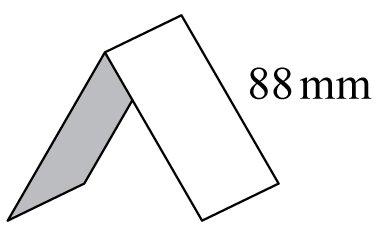
The long edge of each playing card measures $88\text{ mm}$ as illustrated in the following diagram.
Card measuring 88 mm
(f) Find the minimum number of cards needed to create a complete pyramid stack with a vertical height of more than $2\text{ metres}$. The thickness of the cards may be ignored.
[5]

Question 17
Calculator Not Allowed
Difficulty: Easy

[Maximum mark: 6]
The 1st and 5th terms of an arithmetic sequence are $36$ and $12$ respectively.
(a) Find the 13th term of this arithmetic sequence.
[4]
The sum of the first $n$ terms of this arithmetic sequence is zero.
(b) Find the value of $n$.
[2]

Question 18
Calculator Not Allowed
Difficulty: Easy

[Maximum mark: 5]
The 7th term of an arithmetic sequence is $6$.
The sum of the 6th term and the 12th term is $24$.
Find the first term and the common difference.

Question 19
Calculator Allowed
Difficulty: Easy

[Maximum mark: 7]
The sum of the first $n$ terms of a geometric sequence is given by $S_n = \displaystyle\sum_{r=0}^{n-1} 5(\log_2 c)^r$.
(a) Given that $S_n$ converges, find the range of possible values of $c$.
[3]
(b) In the case where $c = 1.5$, find the least value of $n$ such that $|S_\infty - S_n| < 0.1$.
[4]

Question 20
Calculator Allowed
Difficulty: Hard

[Maximum mark: 30]
(a) (i) $S_0(4) = 1^0 + 2^0 + 3^0 + 4^0 = 1 + 1 + 1 + 1 = 4$
[1]
(ii) $S_0(n) = n$
[1]
(b) $S_1(n) = \dfrac{n}{2}(u_1 + u_n) = \dfrac{n}{2}(1 + n) = \dfrac{n^2}{2} + \dfrac{n}{2}$
[3]
(c) $S_2(5) = 1^2 + 2^2 + 3^2 + 4^2 + 5^2 = 1 + 4 + 9 + 16 + 25 = 55$
[1]
(d) (i) $f(x) = x^2$
[1]
(ii) $S_2(n) > \displaystyle\int_0^n x^2 \, dx = \left[\dfrac{x^3}{3}\right]_0^n = \dfrac{n^3}{3} \implies S_2(n) > \dfrac{n^3}{3}$
[4]
(iii) $S_2(n) < \displaystyle\int_0^{n+1} x^2 \, dx = \dfrac{(n+1)^3}{3} = \dfrac{n^3}{3} + n^2 + n + \dfrac{1}{3} < \dfrac{n^3}{3} + n^2 + n$
[4]
(e) (i) $a = u_3 = 3^3 - (3 - 1)^3 = 27 - 8 = 19$
[1]
(ii) $b = \displaystyle\sum_{r=1}^3 u_r = 1 + 7 + 19 = 27$
[1]
(f) (i) $\displaystyle\sum_{r=1}^n u_r = n^3$
[1]
(ii) $\displaystyle\sum_{r=1}^n [r^3 - (r - 1)^3] = (1^3 - 0^3) + (2^3 - 1^3) + \ldots + [n^3 - (n - 1)^3] = n^3$
[3]
(g) (i) $u_n = n^3 - (n - 1)^3 = n^3 - (n^3 - 3n^2 + 3n - 1) = 3n^2 - 3n + 1$
[2]
(ii) $\displaystyle\sum_{r=1}^n u_r = 3\displaystyle\sum_{r=1}^n r^2 - 3\displaystyle\sum_{r=1}^n r + \displaystyle\sum_{r=1}^n 1 = 3S_2(n) - 3S_1(n) + S_0(n)$
[2]
(iii) $n^3 = 3S_2(n) - 3\left(\dfrac{n^2}{2} + \dfrac{n}{2}\right) + n \implies S_2(n) = \dfrac{n^3}{3} + \dfrac{n^2}{2} + \dfrac{n}{6}$
[3]
(iv) $S_2(n) - \dfrac{n^3}{3} = \dfrac{n^2}{2} + \dfrac{n}{6} > 0 \text{ and } \left(\dfrac{n^3}{3} + n^2 + n\right) - S_2(n) = \dfrac{n^2}{2} + \dfrac{5n}{6} > 0 \text{ for } n \in \mathbb{Z}^+$
[2]