Questions in Complex (20)

Question 1
Calculator Not Allowed
Difficulty: Easy

[Maximum mark: 7]
A function $g(x)$ is defined by $g(x) = 2x^3 - 7x^2 + dx - e$, where $d, e \in \mathbb{R}$.
$\alpha, \beta$ and $\gamma$ are the three roots of the equation $g(x) = 0$ where $\alpha, \beta, \gamma \in \mathbb{R}$.
(a) Write down the value of $\alpha + \beta + \gamma$.
[1]
A function $h(z)$ is defined by $h(z) = 2z^5 - 11z^4 + rz^3 + sz^2 + tz - 20$, where $r, s, t \in \mathbb{R}$.
$\alpha, \beta$ and $\gamma$ are also roots of the equation $h(z) = 0$.
It is given that $h(z) = 0$ is satisfied by the complex number $z = p + 3\text{i}$.
(b) Show that $p = 1$.
[3]
It is now given that $h\left(\frac{1}{2}\right) = 0$, and $\alpha, \beta \in \mathbb{Z}^+$, $\alpha < \beta$ and $\gamma \in \mathbb{Q}$.
(c) (i) Find the value of the product $\alpha\beta$.
(ii) Write down the value of $\alpha$ and the value of $\beta$.
[3]

Question 2
Calculator Not Allowed
Difficulty: Medium

[Maximum mark: 20]
Consider $\phi = (a + b\text{i})^3$, where $a, b \in \mathbb{R}$.
(a) In terms of $a$ and $b$, find
(i) the real part of $\phi$;
(ii) the imaginary part of $\phi$.
[3]
(b) Hence, or otherwise, show that $\left(1 + \sqrt{3}\,\text{i}\right)^3 = -8$.
[2]
The roots of the equation $z^3 = -8$ are $u, v$ and $w$, where $u = 1 + \sqrt{3}\,\text{i}$ and $v \in \mathbb{R}$.
(c) Write down $v$ and $w$, giving your answers in Cartesian form.
[2]
On an Argand diagram, $u, v$ and $w$ are represented by the points $\text{U}, \text{V}$ and $\text{W}$ respectively.
(d) Find the area of the triangle $\text{UVW}$.
[3]
Each of the points $\text{U}, \text{V}$ and $\text{W}$ is rotated counter-clockwise (anticlockwise) about $0$ through an angle of $\frac{\pi}{4}$ to form three new points $\text{U}', \text{V}'$ and $\text{W}'$. These points represent the complex numbers $u', v'$ and $w'$ respectively.
(e) Find $u', v'$ and $w'$, giving your answers in the form $r\text{e}^{\text{i}\theta}$, where $-\pi < \theta \le \pi$.
[4]
(f) Given that $u', v'$ and $w'$ are the solutions of $z^3 = c + d\text{i}$, where $c, d \in \mathbb{R}$, find the value of $c$ and the value of $d$.
[3]
It is given that $u, v, w, u', v'$ and $w'$ are all solutions of $z^n = \alpha$ for some $\alpha \in \mathbb{C}$, where $n \in \mathbb{N}$.
(g) Find the smallest positive value of $n$.
[3]

Question 3
Calculator Not Allowed
Difficulty: MEDIUM

[Maximum mark: 20]
Consider $\phi = (a + b\mathrm{i})^3$, where $a, b \in \mathbb{R}$.
(a)
In terms of $a$ and $b$, find
(i) the real part of $\phi$;
(ii) the imaginary part of $\phi$.
[3]
(b) Hence, or otherwise, show that $\left(1 + \sqrt{3}\,\mathrm{i}\right)^3 = -8$.
[2]
The roots of the equation $z^3 = -8$ are $u$, $v$ and $w$, where $u = 1 + \sqrt{3}\,\mathrm{i}$ and $v \in \mathbb{R}$.
(c) Write down $v$ and $w$, giving your answers in Cartesian form.
[2]
On an Argand diagram, $u$, $v$ and $w$ are represented by the points $\text{U}$, $\text{V}$ and $\text{W}$ respectively.
(d) Find the area of the triangle $\text{UVW}$.
[3]
Each of the points $\text{U}$, $\text{V}$ and $\text{W}$ is rotated counter-clockwise (anticlockwise) about $0$ through an angle of $\displaystyle\frac{\pi}{4}$ to form three new points $\text{U}'$, $\text{V}'$ and $\text{W}'$. These points represent the complex numbers $u'$, $v'$ and $w'$ respectively.
(e) Find $u'$, $v'$ and $w'$, giving your answers in the form $r\mathrm{e}^{\mathrm{i}\theta}$, where $-\pi < \theta \leq \pi$.
[4]
(f) Given that $u'$, $v'$ and $w'$ are the solutions of $z^3 = c + d\mathrm{i}$, where $c, d \in \mathbb{R}$, find the value of $c$ and the value of $d$.
[3]
It is given that $u, v, w, u', v'$ and $w'$ are all solutions of $z^n = \alpha$ for some $\alpha \in \mathbb{C}$, where $n \in \mathbb{N}$.
(g) Find the smallest positive value of $n$.
[3]

Question 4
Calculator Not Allowed
Difficulty: Easy

[Maximum mark: 6]
Consider $P(z) = 4m - mz + \dfrac{36}{m}z^2 - z^3$, where $z \in \mathbb{C}$ and $m \in \mathbb{R}^+$.
Given that $z - 3\text{i}$ is a factor of $P(z)$, find the roots of $P(z) = 0$.

Question 5
Calculator Not Allowed
Difficulty: Medium

[Maximum mark: 22]
Consider the complex number $w = \dfrac{4\mathrm{i}}{1 + \mathrm{i}\sqrt{3}}$.
(a) Show that $w = \sqrt{3} + \mathrm{i}$.
[2]
(b) Find
(i) $\quad |w|$;
(ii) $\quad \arg w$.
[3]
(c)
Use De Moivre’s theorem to find the two square roots of $w$. Give your answers in the form $r\mathrm{e}^{\mathrm{i}\theta}$, where $r > 0$ and $-\pi < \theta \le \pi$.
[4]
The complex number $w$ can be expressed in the form $(a + b\mathrm{i})^2$, where $a,\, b \in \mathbb{R}^+$.
(d)
(i) Show that $a^2 = \dfrac{\sqrt{3}}{2} + 1$.
(ii) Find the value of $b^2$.
[8]
(e) Hence, express $\tan\dfrac{\pi}{12}$ in the form $p + q\sqrt{3}$, where $p,\, q \in \mathbb{Z}$.
[5]

Question 6
Calculator Not Allowed
Difficulty: Easy

[Maximum mark: 5]
Consider the complex number $z = 3^{\mathrm{i}-1}$.
(a) Write the integer $3$ in the form $\mathrm{e}^a$ where $a \in \mathbb{R}$.
[1]
(b) Hence, giving your answers in the form $p\cos(\ln q)$ where $p,\, q \in \mathbb{Q}^+$, find
(i) $\operatorname{Re}(z)$;
(ii) $\operatorname{Re}\!\left(\dfrac{1}{z}\right)$.
[4]

Question 7
Calculator Not Allowed
Difficulty: Medium

[Maximum mark: 21]
Consider the complex number $z = x + y\mathrm{i}$, where $x,\, y \in \mathbb{R}$, such that $\vert{}z - (2 + \mathrm{i})\vert{} = 3$.
(a) Show that $x^2 + y^2 - 4x - 2y - 4 = 0$.
[3]
The argument of $\dfrac{z + p}{z - 1}$ is $\dfrac{\pi}{4}$, where $p \in \mathbb{R}$.
(b) Show that $x^2 + y^2 + (p - 1)x + (p + 1)y - p = 0$.
[7]
Two roots of the equation $z^4 + az^3 + bz^2 + cz + d = 0$ are $z_1$ and $z_2$, where $z \in \mathbb{C}$ and $a,\, b,\, c,\, d \in \mathbb{R}$.
Both $z_1$ and $z_2$ satisfy the conditions $\vert{}z - (2 + \mathrm{i})\vert{} = 3$ and $\operatorname{Re}\!\left(\dfrac{z + 4}{z - 1}\right) = \operatorname{Im}\!\left(\dfrac{z + 4}{z - 1}\right)$.
(c) Use the results from parts (a) and (b) to find $z_1$ and $z_2$.
[7]
(d) Find the value of $a$.
[4]

Question 8
Calculator Not Allowed
Difficulty: Easy

[Maximum mark: 6]
Consider the complex number
$z = 3 + k\mathrm{i},$
where $k \in \mathbb{R}$, $k < 0$, and $-\pi < \arg(z) \le \pi$.
Given that $z^5$ is a real number, find the values of $k$ in the form $a\tan b\pi$, where $a\text{, } b \in \mathbb{R}\text{, } b < 0$.

Question 9
Calculator Allowed
Difficulty: Easy

[Maximum mark: 8]
Consider the equation $z^3 = c$, where $z \in \mathbb{C}$ and $c$ is a positive constant.
One of the solutions of the equation is $z = -2 + 2\mathrm{i}\sqrt{3}\,.$
(a) Find the value of $c\,.$
[2]
(b) Write down the other two solutions of $z^3 = c$ giving your answers in the form $a + b\mathrm{i}$, where $a,\, b \in \mathbb{R}\,.$
[2]
(c) Find the solutions of $(\mathrm{i}z)^3 = c$ giving your answers in the form $a + b\mathrm{i}$, where $a,\, b \in \mathbb{R}\,.$
[2]
The solutions of $(\mathrm{i}z)^3 = c$ can be represented on an Argand diagram by three points $\text{A}$, $\text{B}$ and $\text{C}$.
(d) Find the area of the triangle $\text{ABC}$.
[2]

Question 10
Calculator Not Allowed
Difficulty: Medium

[Maximum mark: 20]
Consider the equation $z^4 = 16\text{i}$, where $z \in \mathbb{C}$.
The equation has four roots $z_1, z_2, z_3, z_4$, where $z_i = r(\cos\theta_i + \text{i}\sin\theta_i)$, $r > 0$ and $0 \le \theta_1 < \theta_2 < \theta_3 < \theta_4 < 2\pi$.
(a) Find $z_1, z_2, z_3$ and $z_4$.
[6]
The roots $z_1, z_2, z_3$ and $z_4$ form a geometric sequence.
(b) Find the common ratio of the sequence, expressing your answer in Cartesian form.
[3]
The roots $z_1, z_2, z_3$ and $z_4$ are represented by the points $\text{A}, \text{B}, \text{C}$ and $\text{D}$ respectively on an Argand diagram.
(c) Plot the points $\text{A}, \text{B}, \text{C}$ and $\text{D}$ on an Argand diagram.
[3]
The equation $v^4 = a + b\text{i}$, where $v \in \mathbb{C}$ and $a, b \in \mathbb{R}$ has roots ${z_1}^*, {z_2}^*, {z_3}^*$ and ${z_4}^*$.
(d) Determine the value of $a$ and the value of $b$.
[3]
The midpoint of $[\text{AB}]$ is $\text{A}'$, the midpoint of $[\text{BC}]$ is $\text{B}'$, the midpoint of $[\text{CD}]$ is $\text{C}'$ and the midpoint of $[\text{DA}]$ is $\text{D}'$.
Consider the equation $w^p = 2^q$, where $w \in \mathbb{C}$ and $p, q \in \mathbb{Z}^+$.
Four of the roots of $w^p = 2^q$ are represented by the points $\text{A}', \text{B}', \text{C}'$ and $\text{D}'$.
(e) Find the least possible value of $p$ and the corresponding value of $q$.
[5]

Question 11
Calculator Not Allowed
Difficulty: Easy

[Maximum mark: 7]
Consider the functions $f$, $g$ and $h$ defined as follows for $t \in \mathbb{R}$.
$f(t) = \sin(2t + 1)$
$g(t) = \sin(2t + 3)$
$h(t) = f(t) + g(t)$
(a) Show that $h(t) = \operatorname{Im}\left(\mathrm{e}^{2t\mathrm{i}}(\mathrm{e}^{\mathrm{i}} + \mathrm{e}^{3\mathrm{i}})\right)$.
[2]
(b) Write $\mathrm{e}^{\mathrm{i}} + \mathrm{e}^{3\mathrm{i}}$ in the form $r\mathrm{e}^{\mathrm{i}\theta}$, where $r > 0$ and $-\pi < \theta \le \pi$.
[2]
(c) Hence or otherwise, write $h(t)$ in the form $p\sin(2t + q)$, where $p > 0$ and $0 < q < 2\pi$.
[3]

Question 12
Calculator Not Allowed
Difficulty: Easy

[Maximum mark: 8]
(a) (i) Roots occur in conjugate pairs: $\frac{1}{3} + (a - \mathrm{i}) + (a + \mathrm{i}) + (2 + b\mathrm{i}) + (2 - b\mathrm{i}) = \dfrac{7}{3} \implies \dfrac{1}{3} + 2a + 4 = \dfrac{7}{3} \implies 2a = -2 \implies a = -1$
[3]
(ii) Product of roots: $\left(\dfrac{1}{3}\right)(a^2 + 1)(4 + b^2) = -\left(\dfrac{-26}{3}\right) \implies \dfrac{2(4 + b^2)}{3} = \dfrac{26}{3} \implies 4 + b^2 = 13 \implies b = 3 \quad (\text{since } b > 1)$
[2]
(b) Factors: $(3z - 1)(z - (-1 \pm \mathrm{i}))(z - (2 \pm 3\mathrm{i})) \implies p(z) = (3z - 1)(z^2 + 2z + 2)(z^2 - 4z + 13)$ where $A = 3, B = -1, C = 2, D = 2, E = -4, F = 13$
[3]

Question 13
Calculator Not Allowed
Difficulty: Medium

[Maximum mark: 22]
Consider the quadratic polynomial $Q(z) = z^2 - 2\sqrt{3}z + 4$, where $z \in \mathbb{C}$.
(a)
Find the roots of $Q(z) = 0$,
(i) in Cartesian form;
(ii) in modulus-argument form.
[6]
Now consider the polynomial $P(z) = z^6 + 64$, where $z \in \mathbb{C}$.
(b) Solve $P(z) = 0$. Give your answers in modulus-argument form.
[5]
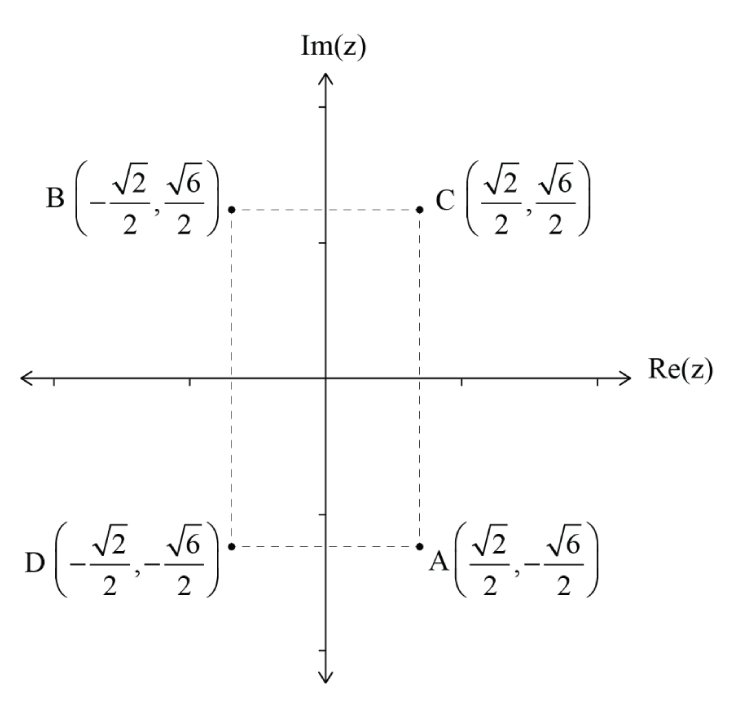
(c) Plot the roots of the equation $P(z) = 0$ on an Argand diagram. Clearly label each root $z_1, z_2, \ldots, z_6$, where $z_2$ is the root located on the positive imaginary axis.
[2]
(d) Verify that $z^2 + 4$ is a factor of $P(z)$.
[2]
The polynomial $P(z)$ can be written as the product of three quadratic factors with real coefficients.
(e) Find the other two quadratic factors of $P(z)$.
[4]
Line segments are drawn from $z_2$ to each of the other roots.
(f) Find the sum of the lengths of these line segments.
[3]

Question 14
Calculator Not Allowed
Difficulty: Easy

[Maximum mark: 8]
Consider the complex number $z_1 = \sqrt{3} - 3\mathrm{i}$.
(a) Express $z_1$ in the form $r\mathrm{e}^{\mathrm{i}\theta}$, where $r > 0$ and $-\pi < \theta \le \pi$.
[3]
Consider the complex number $z_2 = 2\sqrt{3}\mathrm{e}^{\mathrm{i}\frac{5\pi}{6}}$.
The cube roots of $\dfrac{z_2}{z_1}$ are denoted by $u$, $v$ and $w$.
(b) Find $u$, $v$ and $w$.
[5]

Question 15
Calculator Allowed
Difficulty: Easy

[Maximum mark: 6]
A self-service sushi restaurant has a row of $12$ available seats, as shown in the following diagram.
Diagram showing a row of 12 available seats along a counter at a sushi restaurant
Anvi, Vanya and Parita decide to go to the restaurant for lunch.
(a) Find the number of possible ways that they can be seated in this row, if they decide not to sit together as a group of $3$.
[3]
The next day, Anvi, Vanya and Parita are joined by $3$ additional people in the same restaurant, and they sit in the same row of $12$ available seats. Anvi, Vanya and Parita now decide to sit next to each other as a group of $3$.
(b) Find the number of possible ways that these $6$ people can be seated.
[3]

Question 16
Calculator Not Allowed
Difficulty: Medium

[Maximum mark: 20]
(a) It is given that $w = 1 + \mathrm{i}\sqrt{3}$.
(i) Express $w$ in the form $w = r\mathrm{e}^{\mathrm{i}\alpha}$, where $r > 0$ and $-\pi < \alpha \le \pi$.
(ii) Show that $\left(1 + \mathrm{i}\sqrt{3}\right)^8 + \left(1 - \mathrm{i}\sqrt{3}\right)^8 = -256$.
[6]
It is given that $(1 + \mathrm{i}\tan\theta)^n = \displaystyle\frac{\cos n\theta + \mathrm{i}\sin n\theta}{\cos^n\theta}$ for $\cos\theta \ne 0,\ n \in \mathbb{Z}^+$.
(b) Show that $(1 + \mathrm{i}\tan\theta)^4 + (1 - \mathrm{i}\tan\theta)^4 = \displaystyle\frac{2\cos 4\theta}{\cos^4\theta}$.
[3]
(c)
Hence, determine the four roots of the equation $(1 + z)^4 + (1 - z)^4 = 0$, giving your
answers in the form $z = \mathrm{i}\tan\left(\displaystyle\frac{k\pi}{8}\right)$, where $k \in \mathbb{Z}^+$.
[4]
(d) By considering the binomial expansion of $(1 + z)^4 + (1 - z)^4$, show that $\tan\displaystyle\frac{\pi}{8} = \sqrt{3 - 2\sqrt{2}}$.
[7]

Question 17
Calculator Not Allowed
Difficulty: Easy

[Maximum mark: 10]
Let $z = 1 + \cos 2\theta + \text{i}\sin 2\theta$, where $-\dfrac{\pi}{2} < \theta < \dfrac{\pi}{2}$.
(a) Show that
(i) $\arg z = \theta$;
(ii) $|z| = 2\cos\theta$.
[7]
(b) Hence or otherwise, find the value of $\theta$ such that $\arg(z^2) = |z^3|$.
[3]

Question 18
Calculator Not Allowed
Difficulty: Medium

[Maximum mark: 19]
(a) Solve $z^2 = -1 - \sqrt{3}\mathrm{i}$, giving your answers in the form $z = r(\cos\theta + \mathrm{i}\sin\theta)$.
[4]
Let $z_1$ and $z_2$ be the square roots of $-1 - \sqrt{3}\mathrm{i}$, where $\operatorname{Re}(z_1) > 0$.
Let $z_3$ and $z_4$ be the square roots of $-1 + \sqrt{3}\mathrm{i}$, where $\operatorname{Re}(z_3) > 0$.
(b) Expressing your answers in the form $z = a + b\mathrm{i}$, where $a,\, b \in \mathbb{R}$,
(i) find $z_1$ and $z_2$;
(ii) deduce $z_3$ and $z_4$.
[4]
The four roots $z_1,\, z_2,\, z_3$ and $z_4$ are represented by the points $\mathrm{A}$, $\mathrm{B}$, $\mathrm{C}$ and $\mathrm{D}$ respectively on an Argand diagram.

(c) (i) Plot the points $\mathrm{A}$, $\mathrm{B}$, $\mathrm{C}$ and $\mathrm{D}$ on an Argand diagram.

(ii) Find the area of the polygon formed by these four points.

[4]
The four roots $z_1,\, z_2,\, z_3$ and $z_4$ satisfy the equation $z^4 + 2z^2 + 4 = 0$.
The four roots $\dfrac{1}{z_1},\, \dfrac{1}{z_2},\, \dfrac{1}{z_3}$ and $\dfrac{1}{z_4}$ satisfy the equation $pw^4 + qw^2 + r = 0$ where $p,\, q,\, r \in \mathbb{Z}$.
(d) Find the value of $p$, $q$ and $r$.
[3]
The four roots $\dfrac{1}{z_1},\, \dfrac{1}{z_2},\, \dfrac{1}{z_3}$ and $\dfrac{1}{z_4}$ are represented by the points $\mathrm{E}$, $\mathrm{F}$, $\mathrm{G}$ and $\mathrm{H}$ respectively on an Argand diagram.
(e)

(i) Find $\dfrac{1}{z_1}$ in the form $z = a + b\mathrm{i}$, where $a,\, b \in \mathbb{R}$.

(ii) Hence, deduce the area of the polygon formed by these four points.
[4]

Question 19
Calculator Allowed
Difficulty: Hard

[Maximum mark: 25]
This question asks you to explore curves in the complex plane defined by $r = a + b\sin\theta$, where $a$ and $b$ are real constants.
A complex number $z$ can be represented by a point in the complex plane whose position is determined by the modulus, $r$, and the argument, $\theta$, of $z$.
The set of points which satisfy a given relationship between $r$ and $\theta$ form a curve in the complex plane.
Consider a family of curves defined by $r = a + b\sin\theta$, where $a$ and $b$ are real constants.
First consider the case where $a = 4$ and $b = 0$ so that $r = 4$.
The curve defined by $r = 4$ is the set of points in the complex plane which represent complex numbers with a modulus of $4$.
(a) Suppose that $z$ is a complex number such that $r = 4$.
Find all possible values of $z$ such that
(i) $z$ is purely real;
[1]
(ii) $z$ is purely imaginary;
[1]
(iii) the argument of $z$ is $\dfrac{\pi}{4}$.
[1]
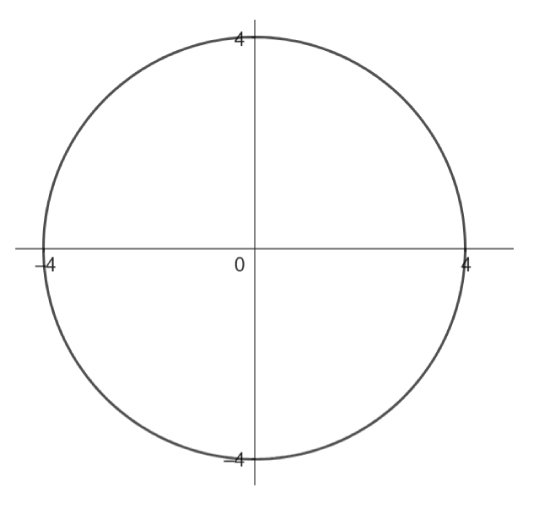
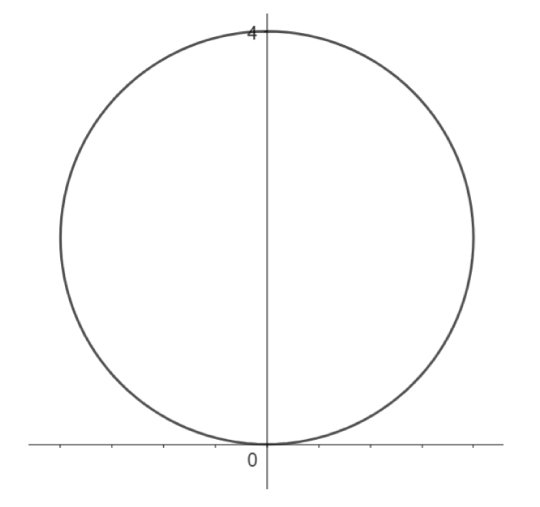
(b) Sketch the curve defined by $r = 4$ on an Argand diagram, showing clearly the values of the intercepts with the real and imaginary axes.
[2]
Now consider the case where $a = 0$ and $b = 4$ so that $r = 4\sin\theta$, where $0 \le \theta \le \pi$.
(c) Suppose that $z$ is a complex number such that $r = 4\sin\theta$, where $0 \le \theta \le \pi$.
(i) Write down the greatest possible value of $r$.
[1]
(ii) For this value of $r$, find $z$.
[2]
(d) Use the identities $x \equiv r\cos\theta$ and $y \equiv r\sin\theta$ to show that the points on the curve defined by $r = 4\sin\theta$ lie on the curve $x^2 + (y - 2)^2 = 4$, where $x = \text{Re}(z)$ and $y = \text{Im}(z)$.
[4]
(e) Consider the curve $x^2 + (y - 2)^2 = 4$.
(i) Find an expression for $\dfrac{\mathrm{d}y}{\mathrm{d}x}$ in terms of $x$ and $y$.
[3]
(ii) Hence or otherwise, find the values of $x$ for which the gradient of the curve is undefined.
[2]
(f)

The curve defined by $r = 4\sin\theta$, where $0 \le \theta \le \pi$, is a circle.

Sketch this curve on an Argand diagram, showing clearly the values of any intercepts with the real and imaginary axes.

[1]
Finally, consider the case where $a = 4$ and $b = 4$.
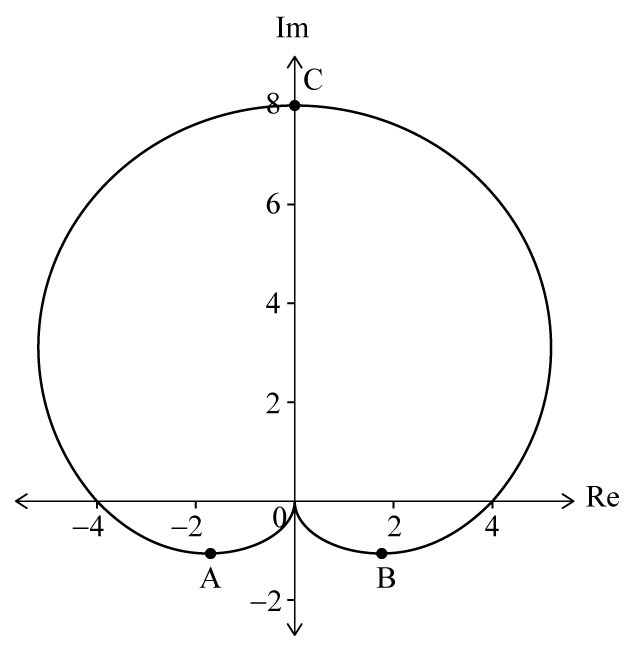
The curve defined by $r = 4 + 4\sin\theta$, where $0 \le \theta \le 2\pi$, is shown on the following Argand diagram. The curve has a horizontal tangent at point $\text{A}$, point $\text{B}$ and point $\text{C}$. The real parts of the numbers represented by $\text{A}$, $\text{B}$ and $\text{C}$ are negative, positive and zero, respectively.
Argand diagram showing cardioid curve with horizontal tangents at A, B, and C
(g) Use the identities $x \equiv r\cos\theta$ and $y \equiv r\sin\theta$ to show that the gradient of the curve at the point $(r\cos\theta,\, r\sin\theta)$ is given by $\dfrac{\mathrm{d}y}{\mathrm{d}x} = \dfrac{\cos\theta(1 + 2\sin\theta)}{1 - \sin\theta - 2\sin^2\theta}$.
[5]
(h) Hence, find the value of $\theta$ which corresponds to the point $\text{A}$.
[2]

Question 20
Calculator Allowed
Difficulty: Hard

[Maximum marks: 29]
This question asks you to explore the relationship between complex numbers and a cuboid whose dimensions and interior diagonal are all integer lengths. This cuboid is called a Pythagorean box.
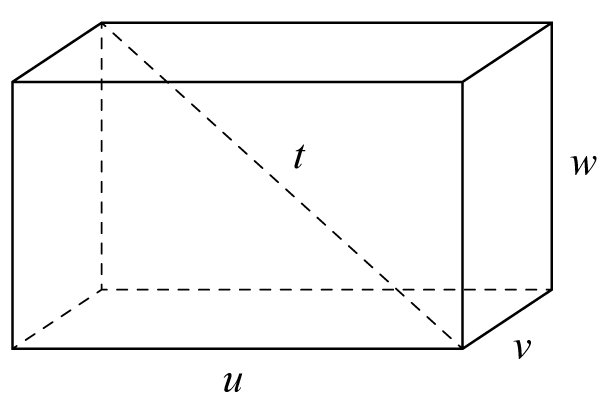
A Pythagorean box, denoted as $\text{PB}(u,\, v,\, w,\, t)$, is a cuboid with dimensions $u \times v \times w$ and an interior diagonal of length $t$, where $u,\, v,\, w,\, t \in \mathbb{Z}^+$. This is shown in the following diagram.
diagram not to scale
Pythagorean box diagram
(a)
For the case where $u = 9$, $v = 2$ and $w = 6$, find the value of $t$.
[2]
The complex numbers $z_1$ and $z_2$ are used to generate a Pythagorean box, $\text{PB}(u,\, v,\, w,\, t)$, if
$u = 2\operatorname{Re}(z_1 z_2^*)$ , $v = 2\operatorname{Im}(z_1 z_2^*)$ , $w = |z_1|^2 - |z_2|^2$ and $t = |z_1|^2 + |z_2|^2$, where $u,\, v,\, w,\, t \in \mathbb{Z}^+$.
Conversely, for any Pythagorean box, $\text{PB}(u,\, v,\, w,\, t)$, there exist two complex numbers, $z_1$ and $z_2$, which satisfy $u$, $v$, $w$ and $t$ as defined above.
Consider the two complex numbers $z_1 = a + bi$ and $z_2 = c + di$, where $a,\, b,\, c,\, d \in \mathbb{Z}^+$.
(b) (i)
Find an expression for $z_1 z_2^*$ in terms of $a$, $b$, $c$ and $d$.
[2]
(ii)
Hence, find an expression for $v$ in terms of $a$, $b$, $c$ and $d$.
[1]
(c)
Consider the case where $z_1 = 3 + 7i$ and $z_2 = c + 6i$ are used to generate a Pythagorean box.
(i)
Show that $v = 14c - 36$.
[1]
(ii)
Show that the only possible values of $c$ are $3$ and $4$.
[4]
(iii)
For $c = 4$, find the values of $u$, $v$, $w$ and $t$.
[5]
There are three Pythagorean boxes with an interior diagonal of length $23$.
(d)
Given that $23 = 1^2 + 2^2 + 3^2 + 3^2$, determine the dimensions of one of these Pythagorean boxes.
[6]
The dimensions and interior diagonal of the Pythagorean box, $\text{PB}(u,\, v,\, w,\, t)$, can be used to form a complex number, $z$, such that $z = \displaystyle\frac{u + vi}{t - w}$.
Consider the Pythagorean box $\text{PB}(26,\, 38,\, 43,\, 63)$.
(e)
Show that, for this Pythagorean box, $z = \displaystyle\frac{13 + 19i}{10}$.
[1]
The complex number $z$ can also be written as $\displaystyle\frac{z_1}{z_2}$, where $z_1$ and $z_2$ generate the Pythagorean box $\text{PB}(26,\, 38,\, 43,\, 63)$.
It is given that $\displaystyle\frac{z_1}{z_2}$ can be expressed as $\displaystyle\frac{z_1 z_2^*}{|z_2|^2}$.
(f) (i)
By considering $t - w$, show that $c^2 + d^2 = 10$.
[2]
(ii)
Hence, given that $c > d$, find $z_1$ and $z_2$.
[5]
(a)
$t = \sqrt{u^2 + v^2 + w^2} = \sqrt{9^2 + 2^2 + 6^2} = \sqrt{81 + 4 + 36} = \sqrt{121}$
(M1)
$t = 11$
A1
(b) (i)
$z_1 z_2^* = (a + bi)(c - di) = ac - adi + bci - bdi^2$
(M1)
$z_1 z_2^* = (ac + bd) + (bc - ad)i$
A1
(ii)
$v = 2\operatorname{Im}(z_1 z_2^*) = 2(bc - ad)$
A1
(c) (i)
$v = 2(7c - 3(6)) = 14c - 36$
A1
(ii)
Since $v \in \mathbb{Z}^+$, $14c - 36 > 0 \implies 14c > 36 \implies c > \frac{18}{7} \approx 2.57$
R1
So $c \ge 3$
A1
Since $w \in \mathbb{Z}^+$, $|z_1|^2 - |z_2|^2 > 0 \implies (3^2 + 7^2) - (c^2 + 6^2) > 0$
M1
$58 - c^2 - 36 > 0 \implies c^2 < 22$, and since $c \in \mathbb{Z}^+$, $c \le 4$
Thus, the only possible values of $c$ are $3$ and $4$.
A1
(iii)
For $c = 4$: $z_1 = 3 + 7i$, $z_2 = 4 + 6i$
(M1)
$u = 2\operatorname{Re}(z_1 z_2^*) = 2(3 \times 4 + 7 \times 6) = 2(12 + 42) = 108$
A1
$v = 14(4) - 36 = 20$
A1
$w = |z_1|^2 - |z_2|^2 = (3^2 + 7^2) - (4^2 + 6^2) = 58 - 52 = 6$
A1
$t = |z_1|^2 + |z_2|^2 = 58 + 52 = 110$
A1
(d)
$t = a^2 + b^2 + c^2 + d^2 = 23 = 1^2 + 2^2 + 3^2 + 3^2$
(M1)
Select $a, b, c, d \in \{1, 2, 3, 3\}$ such that $a^2 + b^2 > c^2 + d^2$ and $bc - ad > 0$:
Let $a = 3$, $b = 3$, $c = 2$, $d = 1$ (giving $|z_1|^2 = 18$ and $|z_2|^2 = 5$)
(M1)(A1)
$u = 2(3 \times 2 + 3 \times 1) = 2(9) = 18$
A1
$v = 2(3 \times 2 - 3 \times 1) = 2(3) = 6$
A1
$w = 18 - 5 = 13$
Hence, dimensions are $18 \times 6 \times 13$ (or $u = 18,\, v = 6,\, w = 13$).
A1
(e)
$z = \displaystyle\frac{26 + 38i}{63 - 43} = \frac{26 + 38i}{20} = \frac{13 + 19i}{10}$
A1
(f) (i)
$t - w = (|z_1|^2 + |z_2|^2) - (|z_1|^2 - |z_2|^2) = 2|z_2|^2 = 2(c^2 + d^2)$
M1
$63 - 43 = 20 \implies 2(c^2 + d^2) = 20 \implies c^2 + d^2 = 10$
A1
(ii)
Since $c, d \in \mathbb{Z}^+$ and $c^2 + d^2 = 10$ with $c > d$: $3^2 + 1^2 = 10 \implies c = 3,\, d = 1$
A1
$z_2 = 3 + i$
A1
$z_1 = z \cdot z_2 = \left(\displaystyle\frac{13 + 19i}{10}\right)(3 + i)$
(M1)
$(13 + 19i)(3 + i) = 39 + 13i + 57i - 19 = 20 + 70i$
(A1)
$z_1 = \displaystyle\frac{20 + 70i}{10} = 2 + 7i$
A1