Questions in Vectors (19)

Question 1
Calculator Allowed
Difficulty: Medium

[Maximum mark: 19]
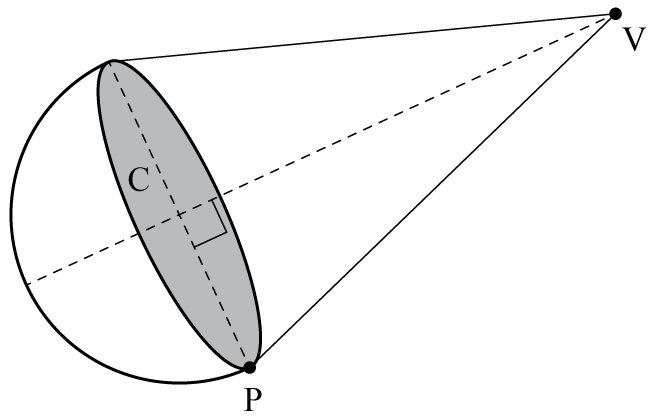
A child’s toy is made from a solid right cone and a solid hemisphere of equal radius. The circular faces of each solid are joined to form a single circle $C$. The point $\text{P}$ lies on the circumference of $C$, and the point $\text{V}$ is the vertex of the cone as shown in the following diagram.
diagram not to scale
Toy made from cone and hemisphere diagram
In this question, all units are given in $\text{cm}$.
The toy is positioned so that the circle $C$ lies completely within the plane defined by $x + 2y - z = 5$.
The point $\text{P}$ has coordinates $(-3,\,6,\,4)$ and the point $\text{V}$ has coordinates $(4,\,16,\,-5)$.
(a) Find a vector equation for the line passing through $\text{V}$ and the centre of $C$.
[3]
(b) Find the coordinates of the centre of $C$.
[3]
(c)
(i) Show that the radius of $C$ is $\sqrt{14}\text{ cm}$.
(ii) Find the total surface area of the toy.
[6]
The toy is rotated so that the position of the vertex is fixed at $\text{V}$ and the image $\text{P}'$ of the point $\text{P}$ has coordinates $(-9,\,11,\,1)$.
(d) Find angle $\text{P}\hat{\text{V}}\text{P}'$, giving your answer in degrees.
[3]
(e)
Find an equation of the plane containing the points $\text{P}$, $\text{V}$ and $\text{P}'$, giving your answer in the form $ax + by + cz = d$, where $a,\, b,\, c,\, d \in \mathbb{Z}$.
[4]

Question 2
Calculator Allowed
Difficulty: Medium

[Maximum mark: 18]
A line $L$ is defined by $L: \ -\dfrac{x}{2} + 1 = y + 4 = \dfrac{z}{3}$.
(a) Find the equation of $L$, expressing your answer in the form $\boldsymbol{r} = \boldsymbol{a} + \lambda\boldsymbol{b}$, where $\lambda \in \mathbb{R}$.
[3]
(b) Determine the minimum distance from the origin $\text{O}$ to the line $L$.
[5]
A plane $\Pi$ is defined by $\Pi: \ 6x - 3y + 5z = 24$.
(c) Verify that $\Pi$ contains $L$.
[3]
A second line $M$ is parallel to $\Pi$.
The line $M$ passes through the point $(4, 1, 2)$ and intersects the $z$-axis.
(d) Find the equation of $M$, expressing your answer in the form $\boldsymbol{s} = \boldsymbol{c} + \mu\boldsymbol{d}$, where $\mu \in \mathbb{R}$.
[7]

Question 3
Calculator Not Allowed
Difficulty: Esy

[Maximum mark: 8]
A line $L_1$ has vector equation $\boldsymbol{r} = \begin{pmatrix} 0 \\ 0 \\ 2 \end{pmatrix} + t\begin{pmatrix} 1 \\ 0 \\ 1 \end{pmatrix}$ where $t \in \mathbb{R}$.
The plane $\Pi_1$ contains the line $L_1$ and passes through the point $(2,\ 1,\ 5)$.
(a) Show that the Cartesian equation of the plane $\Pi_1$ is $x + y - z = -2$.
[4]
Consider the three planes
$\Pi_1 : x + y - z = -2$
$\Pi_2 : 2x + by - z = 3$
$\Pi_3 : x - y + 2z = d$
where $b, d \in \mathbb{Q}^+$.
The three planes intersect in a line.
(b) Find the value of $b$ and the value of $d$.
[4]

Question 4
Calculator Not Allowed
Difficulty: Easy

[Maximum mark: 5]
At 09:00 a helicopter is located at a point $(10,\ 3,\ 0.5)$ relative to a point $\text{O}$ on horizontal ground. The $x$-direction is due east, the $y$-direction is due north and the $z$-direction is vertically upwards.
All distances are measured in kilometres.
The helicopter is flying at a constant height.
The helicopter's position relative to the point $\text{O}$ is given by $\boldsymbol{r} = \begin{pmatrix} 10 \\ 3 \\ 0.5 \end{pmatrix} + 4t\begin{pmatrix} 10 \\ -25 \\ 0 \end{pmatrix}$, where $t$ represents the time in hours since 09:00.
(a) Find the speed of the helicopter.
[2]
At 10:00 the helicopter begins to descend.
During descent the helicopter's vertical height decreases at a constant rate of $16\text{ km\,h}^{-1}$ and its horizontal velocity remains unchanged.
The angle of descent, $\beta$, is defined as the angle between the helicopter's direction of travel and the horizontal.
(b) Find $\beta$, giving your answer in degrees.
[3]

Question 5
Calculator Not Allowed
Difficulty: Easy

[Maximum mark: 8]

Consider non-zero vectors $\mathbf{a},\ \mathbf{b}$ and $\mathbf{c}$ in three-dimensional space.

The non-zero vector $\mathbf{v}$ is defined as $\mathbf{v} = (\mathbf{a}\cdot\mathbf{c})\mathbf{b} - (\mathbf{a}\cdot\mathbf{b})\mathbf{c}$.

(a)
Show that $\mathbf{v}\cdot\mathbf{a} = 0$. [2]

It is given that $\mathbf{b}\times\mathbf{c}$ and $\mathbf{a}\times(\mathbf{b}\times\mathbf{c})$ are non-zero vectors.

(b)
(i) Justify why $\mathbf{b}\cdot(\mathbf{b}\times\mathbf{c}) = 0$.
(ii)
Show that $\mathbf{v}\cdot(\mathbf{b}\times\mathbf{c}) = 0$. [4]
(c)
Hence, state the geometrical relationship between $\mathbf{v}$ and $\mathbf{a}\times(\mathbf{b}\times\mathbf{c})$, briefly justifying your answer. [2]

Question 6
Calculator Allowed
Difficulty: Easy

[Maximum mark: 6]
Consider the following system of linear equations
$2x - y + z = 1$
$2x - 3y - z = 3$
$4x - 3y + z = k$
(a) Find the value of $k$ for which the system of equations has an infinite number of solutions.
[3]
For the value of $k$ found in part (a),
(b)
(i) interpret this result geometrically;
(ii) express the solution to the system of equations in parametric form.
[3]

Question 7
Calculator Not Allowed
Difficulty: Medium

[Maximum mark: 20]
Consider the non-zero vectors $\boldsymbol{u}$ and $\boldsymbol{v}$. Let $\theta$ be the angle between $\boldsymbol{u}$ and $\boldsymbol{v}$.
(a) Using the definitions of $\boldsymbol{u} \cdot \boldsymbol{v}$ and $\boldsymbol{u} \times \boldsymbol{v}$ in terms of $|\boldsymbol{u}|$, $|\boldsymbol{v}|$ and $\theta$, show that $(\boldsymbol{u} \cdot \boldsymbol{v})^2 + |\boldsymbol{u} \times \boldsymbol{v}|^2 = |\boldsymbol{u}|^2 |\boldsymbol{v}|^2$.
[2]
A triangle $\text{ABC}$ has vertices $\text{A}(0, 1, 2)$, $\text{B}(p, q, 3)$ and $\text{C}(3, 2, 1)$, $p, q \in \mathbb{Q}$.
The vectors $\boldsymbol{u}$ and $\boldsymbol{v}$ are defined as $\boldsymbol{u} = \overrightarrow{\text{AB}}$ and $\boldsymbol{v} = \overrightarrow{\text{AC}}$.
It is given that $\boldsymbol{u} \cdot \boldsymbol{v} = 3$ and the area of triangle $\text{ABC}$ is $\sqrt{6}$.
(b) (i) Find the value of $|\boldsymbol{u} \times \boldsymbol{v}|$.
(ii) Hence, or otherwise, find the value of $|\boldsymbol{u}|$.
(iii) Hence, or otherwise, find the possible values of $p$ and the corresponding values of $q$.
[13]
Consider a new point $\text{D}$, the vector $\boldsymbol{w}$ is defined as $\boldsymbol{w} = \overrightarrow{\text{CD}}$.
It is given that $\boldsymbol{u} \cdot \boldsymbol{w} = \boldsymbol{v} \cdot \boldsymbol{w} = 0$ and the area of triangle $\text{ACD}$ is $5$ square units.
(c) Assuming that $p = 1$, find the possible vectors for $\boldsymbol{w}$.
[5]

Question 8
Calculator Allowed
Difficulty: Medium

[Maximum mark: 21]
Consider the points $\text{A}(1,\, 2,\, 3)$, $\text{B}(2,\, -1,\, 5)$ and $\text{C}(4,\, 1,\, 3)$.
(a)
(i) Find $\vec{\text{AB}} \times \vec{\text{AC}}$.
(ii) Hence, or otherwise, find the area of triangle $\text{ABC}$.
[5]
The points $\text{A}$, $\text{B}$ and $\text{C}$ form the triangular base of a right-pyramid with vertex $\text{H}$. This is shown in the following diagram.
diagram not to scale
Right-pyramid ABCH diagram
$\text{M}$ is the midpoint of $[\text{BC}]$ and point $\text{K}$ lies on $[\text{AM}]$ such that $\vec{\text{AK}} = \dfrac{2}{3}\vec{\text{AM}}$.
(b) Show that $\text{K}$ has coordinates $\left(\dfrac{7}{3},\, \dfrac{2}{3},\, \dfrac{11}{3}\right)$.
[3]
The plane $\Pi$ contains the points $\text{A}$, $\text{B}$ and $\text{C}$.
The Cartesian equation of $\Pi$ is $x + 3y + 4z = 19$.
The line $L_1$ is perpendicular to $\Pi$ and passes through $\text{K}$.
(c) Write down a vector equation of $L_1$ in the form $\boldsymbol{r} = \boldsymbol{p} + s\boldsymbol{d}$, where $s \in \mathbb{R}$.
[1]
The point $\text{H}\left(2,\, -\dfrac{1}{3},\, \dfrac{7}{3}\right)$ lies on $L_1$.
(d) Find the volume of the pyramid $\text{ABCH}$.
[3]
The line $L_2$ has vector equation $\boldsymbol{r} = \begin{pmatrix} 1 \\ 2 \\ 3 \end{pmatrix} + t\begin{pmatrix} 1 \\ -3 \\ -2 \end{pmatrix}$ where $t \in \mathbb{R}$.
Let $\alpha$ be the acute angle that $L_2$ makes with $\Pi$.
(e) Find $\alpha$, correct to the nearest degree.
[3]
(f) Show that the lines $L_1$ and $L_2$ are skew.
[6]

Question 9
Calculator Allowed
Difficulty: Easy

6. [Maximum mark: 8]
Consider the vectors $\boldsymbol{a} = \begin{pmatrix} -5 \\ 7 \end{pmatrix}$, $\boldsymbol{b} = \begin{pmatrix} -8 \\ 9 \end{pmatrix}$ and $\boldsymbol{c} = \begin{pmatrix} p \\ -6 \end{pmatrix}$, where $p \in \mathbb{R}$.
(a) Find an expression, in terms of $p$, for
(i) $\boldsymbol{a}\boldsymbol{\cdot}\boldsymbol{c}$;
(ii) $\boldsymbol{b}\boldsymbol{\cdot}\boldsymbol{c}$.
[3]
The angle between $\boldsymbol{a}$ and $\boldsymbol{c}$ is equal to the angle between $\boldsymbol{b}$ and $\boldsymbol{c}$.
(b) Find the value of $p$.
[5]

Question 10
Calculator Not Allowed
Difficulty: Medium

[Maximum mark: 20]
The equation of the plane $\Pi$ has the form $2x + y + az = b$, where $a$ and $b$ are real constants.
The line $L_1$ is parallel to $\Pi$ but does not lie on $\Pi$.
$L_1$ passes through the point $\text{A}(7, -1, 1)$ and has direction vector  $\begin{pmatrix} 0 \\ 2 \\ 1 \end{pmatrix}$.
(a)
(i) Show that $a = -2$.
(ii) Deduce the range of possible values of $b$.
[4]
It is then given that $b = 2$.
The line $L_2$ passes through the point $\text{A}$ and has direction vector  $\begin{pmatrix} 1 \\ 1 \\ -1 \end{pmatrix}$.
$L_2$ intersects $\Pi$ at the point $\text{N}$.
(b) Find the coordinates of $\text{N}$.
[5]
The acute angle between $L_2$ and $\Pi$ is $\alpha$.
(c) Find the exact value of $\sin\alpha$.
[4]
(d) Given that $\text{AN} = \displaystyle\frac{9\sqrt{3}}{5}$, find the distance between $L_1$ and $\Pi$.
[2]
(e) Find the vector equation of the line formed when $L_1$ is reflected in $\Pi$.
[5]

Question 11
Calculator Not Allowed
Difficulty: Medium

[Maximum mark: 21]
The equations of two lines, $L_1$ and $L_2$, are given by:
$L_1 : \boldsymbol{r}_1 = \begin{pmatrix} 5 \\ 4 \\ 2 \end{pmatrix} + s \begin{pmatrix} 1 \\ -1 \\ 1 \end{pmatrix}\text{ where } s \in \mathbb{R}$
$L_2 : \displaystyle\frac{x + 1}{2} = y - 7 = \frac{z + 5}{3}$
(a) Show that the position vector of the point of intersection, $L_1$ and $L_2$ is $\begin{pmatrix} 1 \\ 8 \\ -2 \end{pmatrix}$.
[3]
The plane $\Pi$ contains the lines $L_1$ and $L_2$.
(b) (i)
Write down the equation of $\Pi$, giving your answer in the form $\boldsymbol{r} = \boldsymbol{a} + \lambda\boldsymbol{b} + \mu\boldsymbol{c}$
where $\lambda, \mu \in \mathbb{R}$.
(ii) Given that $\boldsymbol{b} \times \boldsymbol{c} = \begin{pmatrix} -4 \\ -1 \\ 3 \end{pmatrix}$, show that the Cartesian equation of $\Pi$ is $4x + y - 3z = 18$.
[3]
The plane intersects the coordinate axes at $\mathrm{P}(4.5,\, 0,\, 0)$, $\mathrm{Q}(0,\, q,\, 0)$, and $\mathrm{R}(0,\, 0,\, r)$.
(c) Write down the value of
(i) $q$;
(ii) $r$.
[2]
(d) Use a vector method to find the area of the triangle $\mathrm{PQR}$.
[5]
Another line, $L_3$, is normal to $\Pi$ and passes through the point of intersection of $L_1$ and $L_2$.
(e) Write down an equation for $L_3$ in the form $\boldsymbol{r}_3 = \boldsymbol{m} + \gamma\boldsymbol{n}$.
[2]
(f) Given that the point $\mathrm{S}(-11,\, 5,\, 7)$ lies on the line $L_3$, find $\gamma$.
[2]
(g) Hence, find the volume of pyramid $\mathrm{PQRS}$.
[4]

Question 12
Calculator Not Allowed
Difficulty: Easy

[Maximum mark: 8]
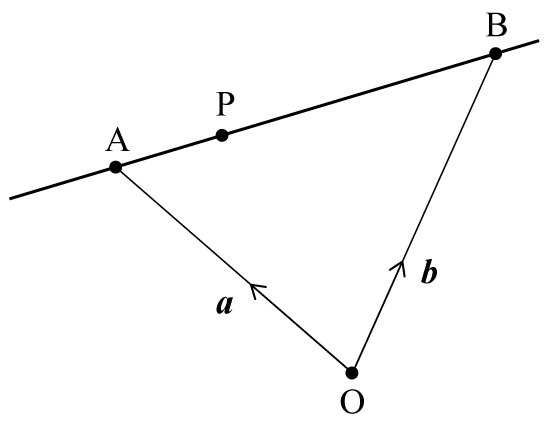
The following diagram shows two points $\text{A}$ and $\text{B}$ such that $\overrightarrow{\text{OA}} = \boldsymbol{a}, \ \overrightarrow{\text{OB}} = \boldsymbol{b}$.
Diagram showing points A and B with position vectors a and b from O, and point P lying on line AB
The point $\text{P}$ lies on $(\text{AB})$ so that $\overrightarrow{\text{AP}} = \lambda\overrightarrow{\text{AB}}$ where $0 < \lambda < 1$.
(a) Show that $\overrightarrow{\text{OP}} = (1 - \lambda)\boldsymbol{a} + \lambda\boldsymbol{b}$.
[1]
It is given that $|\boldsymbol{a}| = 1, \ |\boldsymbol{b}| = 2$ and $\boldsymbol{a} \cdot \boldsymbol{b} = \dfrac{1}{4}$.
(b) In the case that $\overrightarrow{\text{OP}}$ is perpendicular to $\overrightarrow{\text{AB}}$, find the value of $\lambda$.
[7]

Question 13
Calculator Allowed
Difficulty: Hard

2. [Maximum mark: 27]
The following question compares the distance and direction between cities on a flat surface to the distance and direction between cities on a sphere.
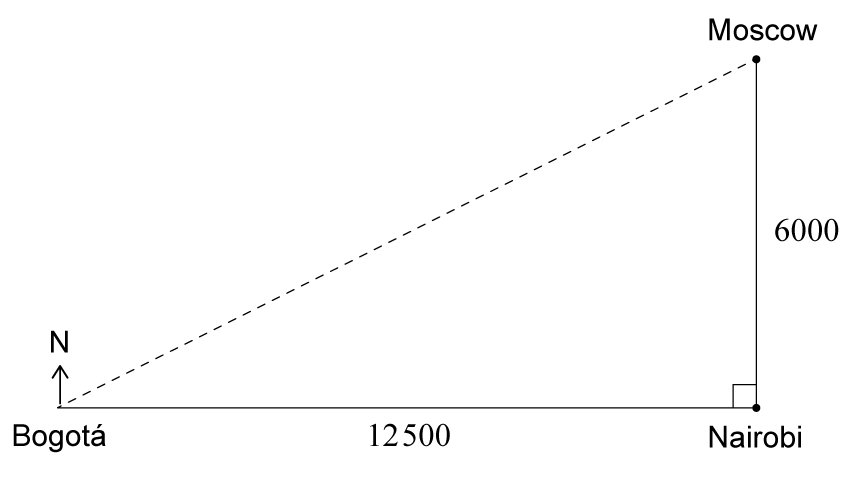
Consider a model where the cities of Bogotá, Moscow, and Nairobi lie on a flat surface. In this model, Nairobi is $6000\text{ km}$ due south of Moscow and Bogotá is $12\,500\text{ km}$ due west of Nairobi, as shown in the following diagram.
diagram not to scale
Flat model showing Bogotá, Nairobi, and Moscow in a right-angled triangle
(a)
(i)
Find the distance from Bogotá to Moscow. [2]
(ii)
Find the bearing of Moscow from Bogotá. Give your answer in degrees. [3]

In reality, these three cities lie on the curved surface of the Earth which will change the distances and directions found in part (a).
Now consider a curved model using a coordinate system $(x, y, z)$ with its origin, $\mathrm{O}$, at the centre of the Earth. The units of this system are thousands of kilometres and the Earth is modelled as a sphere with radius $6000\text{ km}$. The North Pole, $\mathrm{P}$, lies on the $z$-axis, and Nairobi, $\mathrm{N}$, is modelled as being on the equator and lying on the $y$-axis.
Coordinate system with sphere, North Pole P on z-axis and Nairobi N on y-axis
$\mathrm{P}$ has position vector $\vec{\mathrm{OP}} = \boldsymbol{p} = \begin{pmatrix} 0 \\ 0 \\ 6 \end{pmatrix}$ and $\mathrm{N}$ has position vector $\vec{\mathrm{ON}} = \boldsymbol{n} = \begin{pmatrix} 0 \\ 6 \\ 0 \end{pmatrix}$.
(b)
(i)
Use the scalar product to find the angle between $\boldsymbol{p}$ and $\boldsymbol{n}$. [2]
(ii)
Show that the distance between $\mathrm{P}$ and $\mathrm{N}$ along the arc from $\mathrm{P}$ to $\mathrm{N}$ is $3000\pi\text{ km}$. [2]
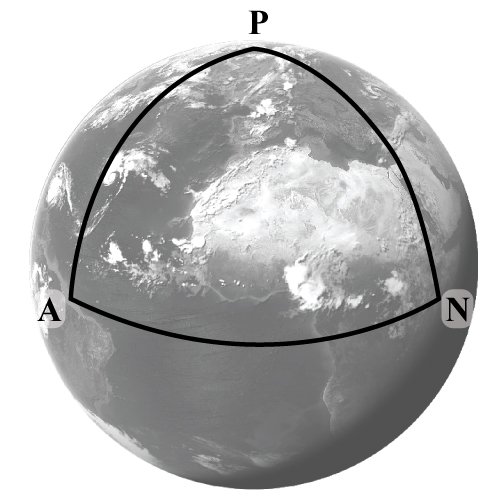
Point $\mathrm{A}$, which is also on the equator, has position vector $\boldsymbol{a} = \begin{pmatrix} 6 \\ 0 \\ 0 \end{pmatrix}$ as shown in the following diagram.
Spherical triangle formed by vertices P, N, and A
$\mathrm{P}$, $\mathrm{N}$ and $\mathrm{A}$, and the arcs connecting them, form a spherical triangle.
The angle at vertex $\mathrm{A}$ is defined as the angle between the vectors $\boldsymbol{a} \times \boldsymbol{p}$ and $\boldsymbol{a} \times \boldsymbol{n}$.
(c)
(i)
Find the vector $\boldsymbol{a} \times \boldsymbol{p}$. [2]
(ii)
Show that the angle at vertex $\mathrm{A}$ in the spherical triangle is $90^\circ$. [3]
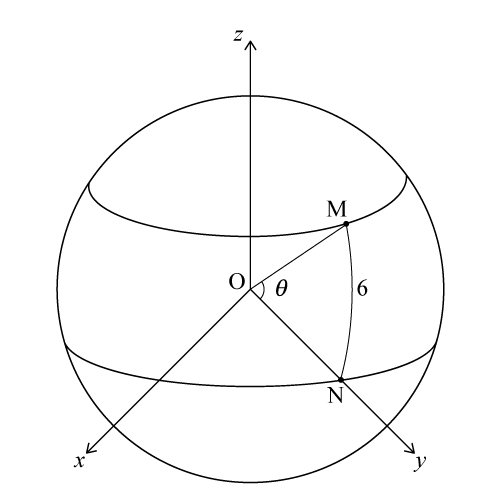
Moscow, $\mathrm{M}$, has position vector $\vec{\mathrm{OM}} = \boldsymbol{m} = \begin{pmatrix} 0 \\ 6\cos\theta \\ 6\sin\theta \end{pmatrix}$, as shown in the following diagram.
Spherical diagram showing Moscow M at angle theta to the equator
The shortest distance between two points on the sphere lies along an arc of a circle on the sphere with centre $\mathrm{O}$. In this model the shortest distance from Moscow to Nairobi is $6000\text{ km}$.
(d)
Show that $\theta = 57.3^\circ$, correct to three significant figures. [2]
Bogotá, $\mathrm{B}$, is west of Nairobi and has position vector $\vec{\mathrm{OB}} = \boldsymbol{b} = \begin{pmatrix} 6\sin 120^\circ \\ 6\cos 120^\circ \\ 0 \end{pmatrix}$.
(e)
Find the shortest distance from Bogotá to Moscow on the sphere. [5]
The bearing from $\mathrm{B}$ to $\mathrm{M}$ is defined as the angle at vertex $\mathrm{B}$ in the spherical triangle containing $\mathrm{B}$, $\mathrm{M}$ and $\mathrm{P}$. It is given that $\boldsymbol{b} \times \boldsymbol{p} = \begin{pmatrix} 36\cos 120^\circ \\ -36\sin 120^\circ \\ 0 \end{pmatrix}$.
(f)
Using the method from part (c), find the bearing from Bogotá to Moscow. [6]

Question 14
Calculator Not Allowed
Difficulty: Easy

[Maximum mark: 6]
The line $L_1$ has vector equation $\boldsymbol{r} = 4\boldsymbol{i} - \boldsymbol{k} + \lambda(a\boldsymbol{j} + \boldsymbol{k})$, where $a,\,\lambda \in \mathbb{R}$.
The line $L_2$ has vector equation $\boldsymbol{r} = \boldsymbol{i} - b\boldsymbol{k} + \mu(\boldsymbol{i} + 2\boldsymbol{j} + 3\boldsymbol{k})$, where $b,\,\mu \in \mathbb{R}$.
The lines $L_1$ and $L_2$ are perpendicular and intersect at a unique point.
Find the value of $a$ and the value of $b$.

Question 15
Calculator Not Allowed
Difficulty: Easy

[Maximum mark: 5]
The line $L_1$ is defined by the Cartesian equation $\dfrac{x - 1}{2} = \dfrac{y + 2}{3} = z$.
(a) Find a vector equation of $L_1$.
[2]
A second line $L_2$ is defined by the vector equation $\boldsymbol{r} = \begin{pmatrix} 0 \\ 4 \\ -8 \end{pmatrix} + t\begin{pmatrix} 1 \\ 0 \\ 2 \end{pmatrix}$, where $t \in \mathbb{R}$.
(b) Find the coordinates of the point where $L_1$ and $L_2$ intersect.
[3]

Question 16
Calculator Not Allowed
Difficulty: MEDIUM

[Maximum mark: 17]
The plane $\Pi_1$ has equation $x + 2y + z = 0$ and the plane $\Pi_2$ has equation $x - y - 2z = 0$.
The acute angle between the planes $\Pi_1$ and $\Pi_2$ is $\theta$.
(a) Show that $\theta = 60^\circ$.
[6]
A third plane $\Pi_3$ is perpendicular to both $\Pi_1$ and $\Pi_2$.
The unique point of intersection of all three planes is the point $\mathrm{R}(5, -5, 5)$.
(b) Find the Cartesian equation of $\Pi_3$.
[4]
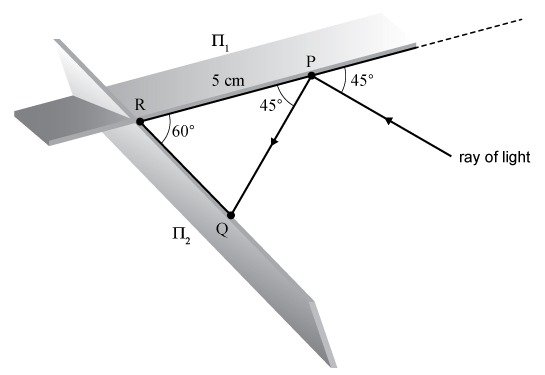
Each of the planes $\Pi_1$ and $\Pi_2$ contains a mirror.
A ray of light is directed towards the mirror in $\Pi_1$. The ray of light forms an angle of $45^\circ$ with $\Pi_1$ and meets it at the point $\mathrm{P}$.
The ray of light is then reflected towards the mirror in $\Pi_2$, and meets $\Pi_2$ at the point $\mathrm{Q}$. The points $\mathrm{P}$ and $\mathrm{Q}$ are contained in $\Pi_3$.
It is given that $\mathrm{PR} = 5\text{ cm}$.
This information is shown on the following diagram.
(This question continues on the following page)
(Question 11 continued)
(c)
(i) Using an appropriate compound angle identity, show that $\sin 75^\circ = \dfrac{\sqrt{2} + \sqrt{6}}{4}$.
(ii)
Find $\mathrm{QR}$, giving your answer in the form $p(\sqrt{q} - 1)\text{ cm}$ where $p,\, q \in \mathbb{Z}$.
[7]

Question 17
Calculator Not Allowed
Difficulty: Medium

[Maximum mark: 19]
The point $\mathrm{P}(-1,\, 1,\, -13)$ lies on the line $L_1$. The line $L_1$ has a direction vector $\begin{pmatrix} 7 \\ 1 \\ 2 \end{pmatrix}$.
(a) Write down a vector equation for $L_1$ in the form $\boldsymbol{r} = \boldsymbol{a} + \lambda\boldsymbol{b}$.
[1]
(b)
Find a vector equation for line $L_2$ in the form $\boldsymbol{s} = \boldsymbol{c} + \mu\boldsymbol{d}$, given that $L_2$ passes through
the points $\mathrm{A}(2,\, -4,\, 2)$ and $\mathrm{B}(7,\, -6,\, 1)$.
[2]
(c) Show that $L_1$ and $L_2$ are skew.
[5]
The point $\mathrm{N}$ lies on $L_2$.
(d) Find $\vec{\mathrm{PN}}\boldsymbol{\cdot}\vec{\mathrm{AB}}$ in terms of $\mu$.
[4]
(e) Given that $\mathrm{N}$ is the point on $L_2$ that lies closest to $\mathrm{P}$, find the coordinates of $\mathrm{N}$.
[3]
(f)
Point $\mathrm{O}$ denotes the origin $(0,\, 0,\, 0)$.
Find the equation of the plane containing points $\mathrm{O}$, $\mathrm{P}$ and $\mathrm{N}$, giving your answer in the
form $\alpha x + \beta y + \gamma z = \delta$, where $\alpha, \beta, \gamma, \delta \in \mathbb{Z}$.
[4]

Question 18
Calculator Not Allowed
Difficulty: Medium

[Maximum mark: 18]
The points $\mathrm{A}(1, -4, 0)$, $\mathrm{B}(-3, -6, 2)$, $\mathrm{C}(-1, -2, 4)$ and $\mathrm{D}$ form a parallelogram, $\mathrm{ABCD}$, where $\mathrm{D}$ is diagonally opposite $\mathrm{B}$.
(a) Find the coordinates of $\mathrm{D}$.
[2]
The diagonals of the parallelogram, $[\mathrm{AC}]$ and $[\mathrm{BD}]$, intersect at point $\mathrm{E}$.
(b) Find the coordinates of $\mathrm{E}$.
[2]
(c)
(i) Given that $\vec{\mathrm{AB}} \times \vec{\mathrm{AD}} = m\begin{pmatrix} -1 \\ 1 \\ -1 \end{pmatrix}$, where $m \in \mathbb{Z}^+$, find the value of $m$.
(ii) Hence, find the area of parallelogram $\mathrm{ABCD}$.
[4]
The plane, $\Pi_1$, contains the parallelogram $\mathrm{ABCD}$.
(d) Find the Cartesian equation of $\Pi_1$.
[2]
A second plane, $\Pi_2$, has Cartesian equation $5x + y - 7z = 1$.
The acute angle between $\Pi_1$ and $\Pi_2$ is $\theta$.
(e) Show that $\cos\theta = \dfrac{1}{5}$.
[3]
The line $L$ passes through $\mathrm{E}$ and is perpendicular to $\Pi_1$.
The line $L$ intersects the plane $\Pi_2$ at point $\mathrm{F}$.
(f) Find the coordinates of $\mathrm{F}$.
[5]

Question 19
Calculator Not Allowed
Difficulty: medium

[Maximum mark: 21]
Two lines, $L_1$ and $L_2$, intersect at point $\text{P}$. Point $\text{A}(2t, 8, 3)$, where $t > 0$, lies on $L_2$. This is shown in the following diagram.
diagram not to scale
Diagram showing two intersecting lines L1 and L2 meeting at point P, with point A lying on L2
The acute angle between the two lines is $\dfrac{\pi}{3}$.
The direction vector of $L_1$ is $\begin{pmatrix} 1 \\ 1 \\ 0 \end{pmatrix}$, and $\overrightarrow{\text{PA}} = \begin{pmatrix} 2t \\ 0 \\ 3 + t \end{pmatrix}$.
(a) Show that $4t = \sqrt{10t^2 + 12t + 18}$.
[4]
(b) Find the value of $t$.
[4]
(c) Hence or otherwise, find the shortest distance from $\text{A}$ to $L_1$.
[4]
A plane, $\Pi$, contains $L_1$ and $L_2$.
(d) Find a normal vector to $\Pi$.
[2]
The base of a right cone lies in $\Pi$, centred at $\text{A}$ such that $L_1$ is a tangent to its base. The volume of the cone is $90\pi\sqrt{3}$ cubic units.
(e) Find the two possible positions of the vertex of the cone.
[7]