Questions in Trigonometry Functions (23)

Question 1
Calculator Not Allowed
Difficulty: Easy

[Maximum mark: 9]
(a) Prove that $\tan\left(\theta - \dfrac{\pi}{4}\right) = \dfrac{\sin 2\theta - 1}{\cos 2\theta}$, where $\theta \ne \dfrac{(2n + 1)\pi}{4}, \ n \in \mathbb{Z}$.
[6]
(b) Hence, or otherwise, solve $\dfrac{\sin x - 1}{\cos x} = \sqrt{3}$ for $0 \le x \le 2\pi$.
[3]

Question 2
Calculator Allowed
Difficulty: Easy

[Maximum mark: 8]
(a) Show that $\dfrac{\cos x}{(1 - \sin x)(1 + \sin x)} \equiv \sec x\text{, where } x \neq (2n + 1)\dfrac{\pi}{2},\, n \in \mathbb{Z}$.
[2]
(b) Use the result from part (a) and the substitution $u = \sin x$ to find $\displaystyle\int \sec x\,\text{d}x$.
[6]

Question 3
Calculator Not Allowed
Difficulty: Medium

[Maximum mark: 19]
(a)
Prove the identity $\cot 2\theta \equiv \dfrac{1}{2}\left(\cot \theta - \dfrac{1}{\cot \theta}\right)$. [3]
(b)
Hence, solve the equation
$\cot 2\theta = \dfrac{3}{2}\cot \theta \left(\cot^2\theta - 1\right)$ $\text{for } 0 < \theta < \pi \text{ where } \theta \neq \dfrac{\pi}{2}$
[6]
(c)
By differentiating both sides of the identity in part (a), show that
$4\mathrm{cosec}^2 2\theta \equiv \mathrm{cosec}^2 \theta + \sec^2 \theta$.
[5]
Consider the right-angled triangle $\Delta\mathrm{PQR}$, where $\mathrm{R\hat{P}Q} = \dfrac{\pi}{2}$.
$\mathrm{PR} = \mathrm{cosec}\,\theta$, $\mathrm{QR} = 2\mathrm{cosec}\,2\theta$, where $0 < \theta < \dfrac{\pi}{2}$ and all lengths are given in metres.
This is shown in the following diagram.
diagram not to scale
Triangle PQR
$\mathrm{QR}$ has length $L$ metres and $\Delta\mathrm{PQR}$ has area $A$ square metres.
(d)
Calculate the ratio $L : A$ in the form $n : 1$, where $n \in \mathbb{Z}^+$. [5]

Question 4
Calculator Allowed
Difficulty: Easy

[Maximum mark: 6]
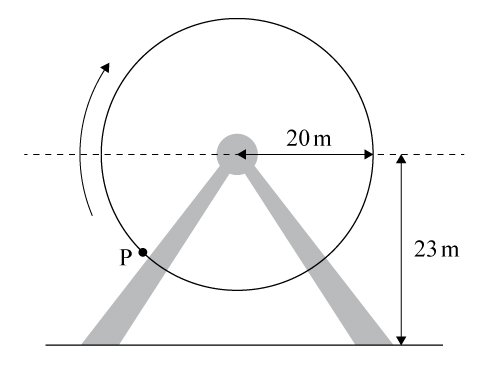
A Ferris wheel with radius $20\text{ metres}$ rotates at a constant speed. The centre of the wheel is $23\text{ metres}$ above the ground, as shown in the following diagram. $\text{P}$ is a point on the wheel. The wheel starts moving with $\text{P}$ at the lowest point and completes one revolution in $4\text{ minutes}$.
diagram not to scale
Ferris wheel diagram
The height, $h\text{ metres}$, of $\text{P}$ above the ground after $t\text{ minutes}$ is given by
$h = a - b\cos(ct)^\circ\text{, where } a, b, c \in \mathbb{Z}^+.$
(a) Find the value of $a$, the value of $b$ and the value of $c$.
[4]
The height can also be given as $h(t) = a - b\sin(c(t + d))^\circ\text{, where } d \in \mathbb{Z}^+.$
(b) Find the smallest positive value of $d$.
[2]

Question 5
Calculator Not Allowed
Difficulty: Easy

[Maximum mark: 6]
A particle moves in a straight line such that it passes through a fixed point $\text{O}$ at time $t = 0$, where $t$ represents time measured in seconds after passing $\text{O}$. For $0 \le t \le 10$ its velocity, $v$ metres per second, is given by $v = 2\sin(0.5t) + 0.3t - 2$.
The graph of $v$ is shown in the following diagram.
<img src="https://kaizenkinesis.com/wp-content/uploads/2026/11/d-128.jpg" alt="Graph of velocity v against time t for 0 <= t
(a) Find the smallest value of $t$ when the particle changes direction.
[2]
The displacement of the particle is measured in metres from $\text{O}$.
(b) Find the range of values of $t$ for which the displacement of the particle is increasing.
[2]
(c) Find the displacement of the particle relative to $\text{O}$ when $t = 10$.
[2]

Question 6
Calculator Allowed
Difficulty: Easy

[Maximum mark: 6]
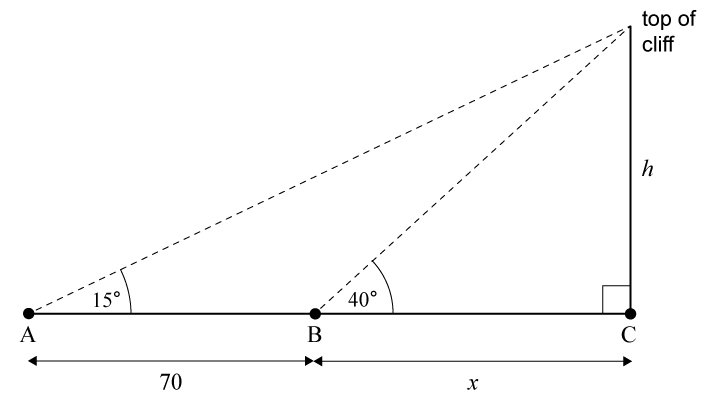
A ship is sailing directly towards a vertical cliff of height $h\text{ metres}$.
diagram not to scale
Trigonometry cliff diagram
When the ship is at point $\text{A}$, the angle of elevation to the top of the cliff is $15^\circ$. After sailing a further $70\text{ metres}$ towards the cliff, the ship reaches point $\text{B}$, and the angle of elevation to the top of the cliff is $40^\circ$.
Point $\text{C}$ is at the base of the cliff, and $\text{BC} = x\text{ metres}$.
(a) Find an expression in terms of $h$ and $x$ for
(i) $\tan 40^\circ$;
(ii) $\tan 15^\circ$.
[2]
(b) Hence, find the value of $x$.
[2]
(c) Find the value of $h$.
[2]

Question 7
Calculator Not Allowed
Difficulty: Medium

[Maximum mark: 15]
A trapezoid $\text{ABCD}$ is inscribed in a semicircle centred at $\text{O}$, of radius $2\text{ cm}$.
The longer parallel side $[\text{AD}]$ is along the diameter of the semicircle.
The trapezoid is defined by the angle, $\theta$, when the radius is rotated anticlockwise (counterclockwise) from the positive $x$-axis where $0 < \theta < \dfrac{\pi}{2}$.
This is shown in the following diagram.
diagram not to scale
Trapezoid ABCD inscribed in a semicircle
The area of the trapezoid can be considered as the sum of the area of three triangles.
(a) Find the area of the trapezoid when $\theta = \dfrac{\pi}{6}$.
[4]
(b) Find an expression for the area of the trapezoid $A(\theta)$, in terms of $\theta$. Give your answer in the form $a\sin\theta + b\sin 2\theta$, where $a, b \in \mathbb{Z}^+$.
[3]
(c)
(i) Find $A'(\theta)$.
(ii) Hence, find the maximum possible area of the trapezoid.
[6]
Consider the case when $\theta$ approaches $\dfrac{\pi}{2}$.
(d)
(i) Describe the effect on the shape of $\text{ABCD}$.
(ii) The area of $\text{ABCD}$ approaches the value $k$. Find the value of $k$.
[2]

Question 8
Calculator Not Allowed
Difficulty: Easy

[Maximum mark: 7]
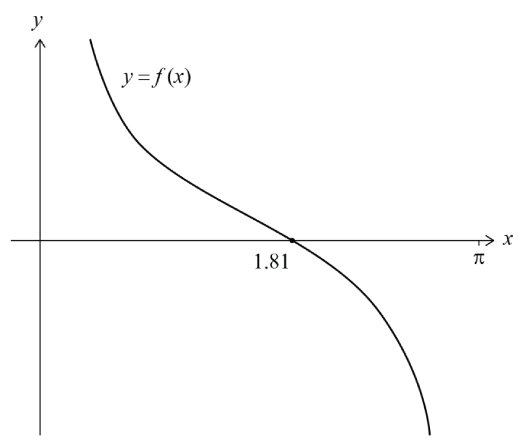
Consider the function $f(x) = 4\cot x + \sin x$, where $0 < x < \pi$.
(a) (i) Write $f(x)$ in terms of $\sin x$ and $\cos x$.
(ii) Hence or otherwise, sketch the graph of $y = f(x)$, showing the value of the $x$-intercept.
[3]
(b) Find the value of $f^{-1}(2)$.
[1]
It is given that $\sec\alpha = 1.5$, where $0 < \alpha < \pi$.
(c) Find the value of $f(\alpha)$.
[3]

Question 9
Calculator Not Allowed
Difficulty: Easy

[Maximum mark: 8]
Consider the function $f(x) = \arccos x$ for $-1 \le x \le 1$.
(a)
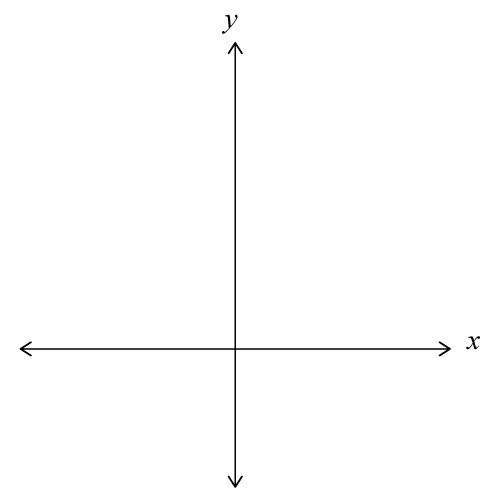
On the set of axes below sketch the graph of $y = f(x)$.
On your sketch clearly indicate the $y$-intercept and coordinates of the end points.
Set of axes for sketching y = arccos(x)
[2]
(b) Solve $\arccos(x) + \arccos(x\sqrt{3}) = \dfrac{3\pi}{2}$, for $-\dfrac{1}{\sqrt{3}} \le x \le \dfrac{1}{\sqrt{3}}$.
[6]

Question 10
Calculator Not Allowed
Difficulty: Easy

[Maximum mark: 4]
Consider the function $f(x) = a\tan(2x) + b$, where $x \neq \dfrac{(2n+1)\pi}{4}$, $n \in \mathbb{Z}$ and $a, b \in \mathbb{R}$.
(a) Write down the period of $f$.
The graph of $y = f(x)$ passes through the points $\left(\dfrac{\pi}{12},\ 5\right)$ and $\left(\dfrac{\pi}{3},\ 7\right)$.
(b) Find the value of $a$ and the value of $b$.

Question 11
Calculator Not Allowed
Difficulty: Easy

[Maximum mark: 7]
Consider the function $g(x) = a\cos(bx) - 3$, where $x \in \mathbb{R}$ and $a, b \in \mathbb{R}$.
The following diagram shows part of the graph of $g$.
Part of the graph of g showing local minimum at (0, -8) and local maximum at (16, 2)
The graph of $g$ has a local minimum at $(0,\, -8)$ and a local maximum at $(16,\, 2)$.
(a) Find the value of
(i) $a$;
(ii) $b$, where $b > 0$.
[3]
(b) Write down the smallest positive value of the constant $k$ such that $g(x + k) = g(x)$ for all $x$.
[1]
(c) The function $g(x)$ can be written in the form $f(x) = p\sin(b(x - q)) - 3$ where $p, q \in \mathbb{Z}^+$.
(i) Find the smallest positive value of $q$.
(ii) For this value of $q$, write down the value of $p$.
[3]

Question 12
Calculator Not Allowed
Difficulty: Easy

[Maximum mark: 5]
Find the exact value of $\sec 75^\circ$. Express your answer in the form $\sqrt{m} + \sqrt{n}$ , where $m\text{, } n \in \mathbb{Z}^+$.

Question 13
Calculator Not Allowed
Difficulty: Easy

[Maximum mark: 5][cite: 35]
(a) Show that $3\cos 2x + 11\sin x = 3 + 11\sin x - 6\sin^2 x$.[cite: 35]
[2][cite: 35]
(b) Hence, or otherwise, solve the equation $3\cos 2x + 11\sin x - 6 = 0$ for $0^\circ \leq x \leq 180^\circ$.[cite: 35]
[3][cite: 35]

Question 14
Calculator Not Allowed
Difficulty: Easy

[Maximum mark: 8]
(a) Show that $\sin 3\theta \equiv 3\sin\theta - 4\sin^3\theta$.
[4]
(b)
Hence, describe a sequence of transformations that maps the graph of $y = \sin\theta$ onto
the graph of $y = 6\sin\!\left(\theta + \dfrac{\pi}{6}\right) - 8\sin^3\!\left(\theta + \dfrac{\pi}{6}\right)$.
[4]

Question 15
Calculator Not Allowed
Difficulty: Easy

[Maximum mark: 6]
Solve $\cos 2x = \sin x$, where $-\pi \le x \le \pi$.

Question 16
Calculator Not Allowed
Difficulty: Easy

[Maximum mark: 4]
Solve $\tan\left(2x - 5^\circ\right) = 1$ for $0^\circ \le x \le 180^\circ$.

Question 17
Calculator Not Allowed
Difficulty: Easy

[Maximum mark: 5]
Solve the equation $2\cos 2\theta - 5\cos\theta + 2 = 0$, where $\pi \le \theta \le 2\pi$.

Question 18
Calculator Not Allowed
Difficulty: Medium

[Maximum mark: 16]
Sule Skerry and Rockall are small islands in the Atlantic Ocean, in the same time zone.
On a given day, the height of water in metres at Sule Skerry is modelled by the function $H(t) = 1.63\sin(0.513(t - 8.20)) + 2.13$, where $t$ is the number of hours after midnight.
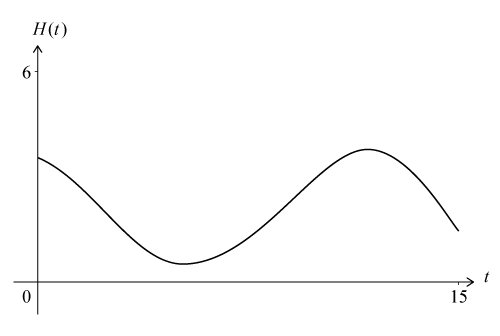
The following graph shows the height of the water for $15$ hours, starting at midnight.
At low tide the height of the water is $0.50\text{ m}$. At high tide the height of the water is $3.76\text{ m}$.
All heights are given correct to two decimal places.
Graph of water height H(t) against time t for 15 hours starting at midnight
(a) The length of time between the first low tide and the first high tide is $6$ hours and $m$ minutes. Find the value of $m$ to the nearest integer.
[3]
(b) Between two consecutive high tides, determine the length of time, in hours, for which the height of the water is less than $1$ metre.
[2]
(c) Find the rate of change of the height of the water when $t = 13$, giving your answer in metres per hour.
[2]
On the same day, the height of water at the second island, Rockall, is modelled by the function $h(t) = a\sin(b(t - c)) + d$, where $t$ is the number of hours after midnight, and $a, b, c, d > 0$.
The first low tide occurs at $02:41$ when the height of the water is $0.40\text{ m}$.
The first high tide occurs at $09:02$ when the height of the water is $2.74\text{ m}$.
(d) Find the values of $a, b, c$ and $d$.
[7]
When $t = T$, the height of the water at Sule Skerry is the same as the height of the water at Rockall for the first time.
(e) Find the value of $T$.
[2]