Questions in Rational Functions (10)

Question 1
Calculator Not Allowed
Difficulty: Medium

[Maximum mark: 16]
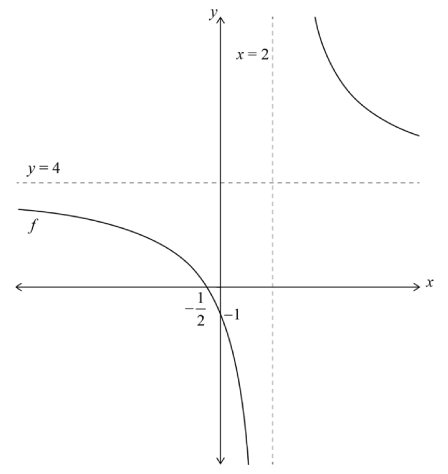
Consider the function $f(x) = \frac{4x + 2}{x - 2}$, $x \ne 2$.
(a) Sketch the graph of $y = f(x)$. On your sketch, indicate the values of any axis intercepts and label any asymptotes with their equations.
[5]
(b) Write down the range of $f$.
[1]
Consider the function $g(x) = x^2 + bx + c$. The graph of $g$ has an axis of symmetry at $x = 2$.
The two roots of $g(x) = 0$ are $-\frac{1}{2}$ and $p$, where $p \in \mathbb{Q}$.
(c) Show that $p = \frac{9}{2}$.
[1]
(d) Find the value of $b$ and the value of $c$.
[3]
(e) Find the $y$-coordinate of the vertex of the graph of $y = g(x)$.
[2]
(f) Find the product of the solutions of the equation $f(x) = g(x)$.
[4]

Question 2
Calculator Not Allowed
Difficulty: Easy

[Maximum mark: 8]
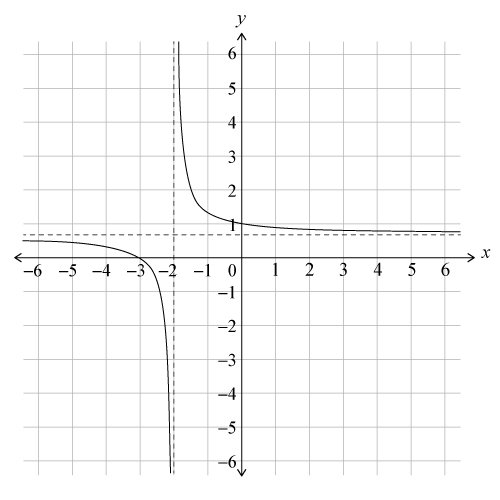
A function $f$ is defined by $f(x) = \frac{2(x + 3)}{3(x + 2)}$, where $x \in \mathbb{R}, x \ne -2$.
The graph $y = f(x)$ is shown below.
Graph of y = f(x) showing vertical asymptote x = -2 and horizontal asymptote y = 2/3
(a) Write down the equation of the horizontal asymptote.
[1]
Consider $g(x) = mx + 1$, where $m \in \mathbb{R}, m \ne 0$.
(b) (i) Write down the number of solutions to $f(x) = g(x)$ for $m > 0$.
(ii) Determine the value of $m$ such that $f(x) = g(x)$ has only one solution for $x$.
(iii) Determine the range of values for $m$, where $f(x) = g(x)$ has two solutions for $x \ge 0$.
[7]

Question 3
Calculator Not Allowed
Difficulty: Easy

Question 4
Calculator Not Allowed
Difficulty: Easy

[Maximum mark: 7]
Consider the function $f$. The graph of $f$ has a local maximum at $\mathrm{A}\left(-1, -\dfrac{5}{2}\right)$, a local minimum at $\mathrm{B}\left(0, \dfrac{15}{2}\right)$, a vertical asymptote at $x = -\dfrac{1}{2}$ and an oblique asymptote $y = 5x + 5$.
This information and part of the graph of $f$ is shown in the following diagram.
Graph of f with asymptotes and extrema
(This question continues on the following page)
(Question 6 continued)
(a) On the following grid, sketch the graph of $y = |f(x)|$, clearly indicating any asymptotes.
Grid for part (a)
[4]
(b) On the following grid, sketch the graph of $y = \dfrac{15}{f(x)}$, clearly indicating any asymptotes and intercepts with the axes.
Grid for part (b)
[3]

Question 5
Calculator Not Allowed
Difficulty: MEDIUM

[Maximum mark: 16]
Consider the function $f(x) = \displaystyle\frac{4x + 2}{x - 2}\text{, } x \neq 2$.
(a) Sketch the graph of $y = f(x)$. On your sketch, indicate the values of any axis intercepts and label any asymptotes with their equations.
[5]
(b) Write down the range of $f$.
[1]
Consider the function $g(x) = x^2 + bx + c$. The graph of $g$ has an axis of symmetry at $x = 2$.
The two roots of $g(x) = 0$ are $-\displaystyle\frac{1}{2}$ and $p$, where $p \in \mathbb{Q}$.
(c) Show that $p = \displaystyle\frac{9}{2}$.
[1]
(d) Find the value of $b$ and the value of $c$.
[3]
(e) Find the $y$-coordinate of the vertex of the graph of $y = g(x)$.
[2]
(f) Find the product of the solutions of the equation $f(x) = g(x)$.
[4]

Question 6
Calculator Not Allowed
Difficulty: Easy

[Maximum mark: 8]
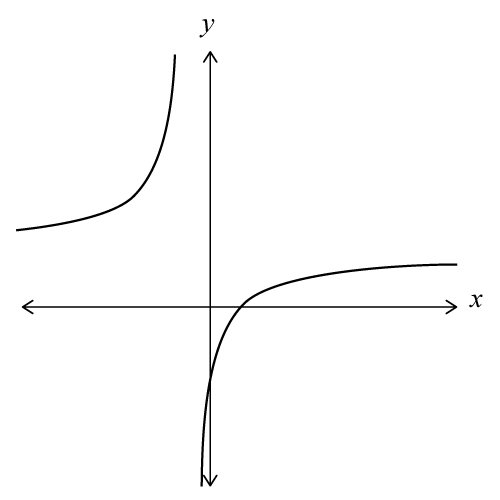
The following diagram shows the graph of $y = \displaystyle\frac{Ax + B}{x - 4}$, where $x \in \mathbb{R}$, $x \neq 4$ and $A, B \in \mathbb{Z}$.
The graph passes through the points $\mathrm{P}(-10,\, 1)$ and $\mathrm{Q}(3,\, -12)$.
x y <!-- Left branch (x $\mathrm{P}(-10,\, 1)$ $\mathrm{Q}(3,\, -12)$
(a) Determine the value of $A$ and the value of $B$.
[3]
(b)
Describe a sequence of transformations that would map the graph of $y = \displaystyle\frac{1}{x}$ onto the
graph of $y = \displaystyle\frac{Ax + B}{x - 4}$.
[5]

Question 7
Calculator Allowed
Difficulty: Medium

[Maximum mark: 21]
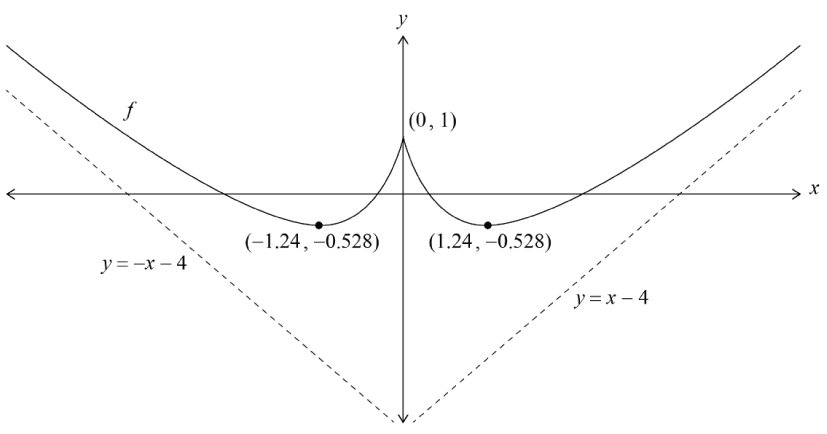
The function $f$ is defined as $f(x) = \dfrac{x^2 + ax + b}{x + 1}$, where $x \neq -1$ and $a, b \in \mathbb{Z}$.
First consider the case where $\displaystyle\lim_{x \to -1} f(x)$ is finite.
(a)
(i) Show that $b = a - 1$.
(ii) Find $\displaystyle\lim_{x \to -1} f(x)$ in terms of $a$.
[4]
Now consider the case where the graph of $f$ has a vertical asymptote, an oblique asymptote with equation $y = x - 4$, and at least one point of zero gradient.
(b) Write down the equation of the vertical asymptote.
[1]
(c) Show that $a = -3$.
[3]
(d) Show that $b \ge -3$.
[6]
In the case where $a = -3$ and $b = 1$
(e)
(i) sketch the graph of $y = f(|x|)$, showing any asymptotes with their equations, the value of the intercept with the $y$-axis, and the coordinates of any local maximum or minimum points;
(ii) solve $f(|x|) < f(x)$.
[7]

Question 8
Calculator Not Allowed
Difficulty: Easy

[Maximum mark: 5]
The function $f$ is defined by $f(x) = \dfrac{3x - 2}{2x + 1}$ for $x \in \mathbb{R},\ x \ne -\dfrac{1}{2}$.
The following diagram shows part of the graph of $y = f(x)$.
Graph of y = f(x)
(a) Write down the value of $f(0)$.
[1]
(b) Write down the equation of the horizontal asymptote.
[1]
The function $g$ is defined by $g(x) = -f(x)$ for $x \ge 0$.
(c) Find the range of $g$.
[3]
(This question continues on the following page)

Question 9
Calculator Not Allowed
Difficulty: Easy

[Maximum mark: 7]
The function $f$ is defined by $f(x) = \dfrac{7x + 7}{2x - 4}$ for $x \in \mathbb{R}, \ x \ne 2$.
(a) Find the zero of $f(x)$.
[2]
(b) For the graph of $y = f(x)$, write down the equation of
(i) the vertical asymptote;
(ii) the horizontal asymptote.
[2]
(c) Find $f^{-1}(x)$, the inverse function of $f(x)$.
[3]

Question 10
Calculator Allowed
Difficulty: Medium

[Maximum mark: 17]
The function $f$ is defined by
$\displaystyle f(x) = \frac{x^2 + bx + c}{x + d},$
where $x \in \mathbb{R}$, $x \neq -d$ and $b,\, c,\, d \in \mathbb{Z}$.
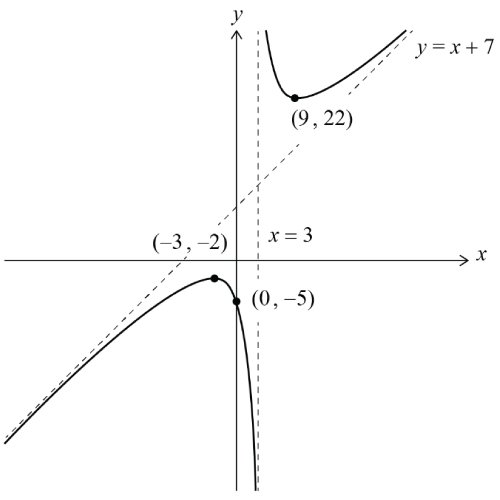
The graph of $y = f(x)$ has asymptotes $x = 3$ and $y = x + 7$.
(a) Write down the value of $d$.
[1]
(b) Show that $b = 4$.
[2]
The graph of $y = f(x)$ has a local maximum at $x = -3$.
(c) Find the value of $c$.
[4]
(d) Sketch the graph of $y = f(x)$ for $-30 \le x \le 30$. Show the values of any axis intercepts and the coordinates of any local maxima and minima, and label the asymptotes.
[4]
The equation $|f(x)| = k$ has four solutions.
(e) Find the range of possible values of $k$.
[2]
The graph of $y = g(x)$ is obtained from the graph of $y = f(x)$ by a translation of $\begin{pmatrix} 2 \\ 3 \end{pmatrix}$.
(f) Find the equations of the vertical asymptotes of $y = \dfrac{1}{g(x)}$.
[4]