Questions in Integral Calculus (37)

Question 1
Calculator Allowed
Difficulty: Medium

12. [Maximum mark: 21]
(a) Find $\displaystyle\int (x^2 - 5)\mathrm{e}^x\,\mathrm{d}x$.
[6]
Consider the differential equation $\dfrac{\mathrm{d}y}{\mathrm{d}x} = x^2 - y - 5$.
(b) By solving the differential equation, show that its solution can be expressed in the form $y = x^2 - 2x - 3 + C\mathrm{e}^{-x}$, where $C$ is a constant.
[4]
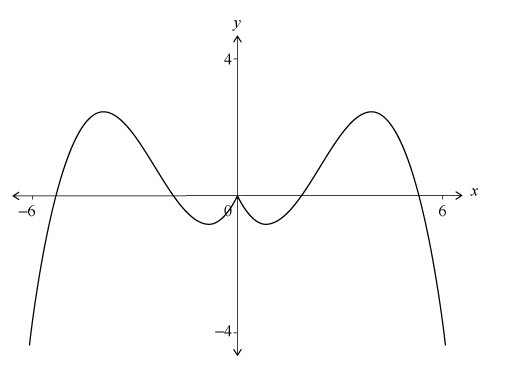
(c) Sketch the curve of the particular solution which passes through the point $(-3,\, 2)$, for $-4 \le x \le 4$, clearly labelling the coordinates of any local maximum and minimum points.
[5]
Consider the family of curves that are solutions of the differential equation.
The tangent at $x = -3$ is drawn for each of these curves.
(d) By considering the curve which passes through the point $(-3,\, p)$ and the curve which passes through the point $(-3,\, q)$, where $p,\, q \in \mathbb{R},\ p \neq q$, show that all these tangents intersect at a common point, and state its coordinates.
[6]

Question 2
Calculator Allowed
Difficulty: Easy

[Maximum mark: 6]
A closed cylindrical container has base radius $r\text{ cm}$ and height $h\text{ cm}$. The container has a volume of $500\text{ cm}^3$.
(a) Show that $h = \dfrac{500}{\pi r^2}$.
[1]
Let the total external surface area of the cylinder be $A\text{ cm}^2$.
(b) Show that $A = 2\pi r^2 + \dfrac{1000}{r}$.
[2]
(c) By using a graph, or otherwise,
(i) find the minimum value of $A$;
(ii) write down the corresponding value of $r$.
[3]

Question 3
Calculator Not Allowed
Difficulty: Easy

[Maximum mark: 7]
A line with equation $y = -3x + 9$ intersects the axes at the points $\text{P}(0,\, 9)$ and $\text{Q}(3,\, 0)$.
A parabola of the form $y = ax^2 + c$, where $a,\, c \in \mathbb{Z}$, also passes through the points $\text{P}$ and $\text{Q}$.
This is shown in the following diagram.
Parabola and line intersecting at P and Q
(a)
(i) Write down the value of $c$.
(ii) Find the value of $a$.
[3]
The region enclosed by the line and the parabola is shaded in the following diagram.
Region enclosed by line and parabola shaded
(b) Find the area of the shaded region.
[4]

Question 4
Calculator Not Allowed
Difficulty: Easy

[Maximum mark: 14]
A mathematics class of $15$ students plays a game which requires three equal size teams.
(a) Find the total number of ways that the three teams can be chosen.
[3]
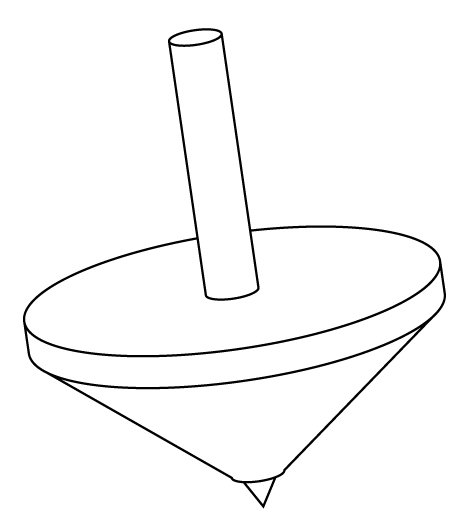
The game involves the spinning of a top.
A spinning top in motion
The time, $T$, in minutes that the spinning top is in motion can be modelled by the probability density function $f$ where
$$f(t) = \begin{cases} k t \mathrm{e}^{-3t}, & t \ge 0 \\ 0, & \text{otherwise} \end{cases}$$
and $k \in \mathbb{Z}^+$.
(b) Show that $\displaystyle\int_{0}^{a} f(t)\,\mathrm{d}t = \dfrac{k}{9}\left[1 - (3a+1)\mathrm{e}^{-3a}\right]$, where $a \in \mathbb{R}^+$.
[4]
(c) (i) Use l'Hôpital's rule to find $\displaystyle\lim_{x \to \infty} (3x+1)\mathrm{e}^{-3x}$.
(ii) Hence, by considering $\displaystyle\lim_{a \to \infty} \int_{0}^{a} f(t)\,\mathrm{d}t$, find the value of $k$.
[5]
(d) Find the median length of time that a spinning top is in motion.
[2]

Question 5
Calculator Not Allowed
Difficulty: Easy

[Maximum mark: 5]

A particle $P$ is travelling along a straight line, with displacement measured relative to a point $\mathrm{O}$ on the line. The velocity, $v\,\mathrm{m\,s^{-1}}$, of the particle at time $t$ seconds is given by

$$v = \frac{1}{t + 1} + \mathrm{e}^{-t}, \quad \text{where } t \ge 0.$$
(a)
Find $\displaystyle\int \left(\frac{1}{t + 1} + \mathrm{e}^{-t}\right)\mathrm{d}t$. [2]

Initially the particle is at $\mathrm{O}$.

(b)
Find an expression for the displacement, $s$ metres, in terms of $t$. [3]

Question 6
Calculator Not Allowed
Difficulty: Easy

[Maximum mark: 6]
A population, $P$, has a rate of change modelled by $\dfrac{\mathrm{d}P}{\mathrm{d}t} = -104000\mathrm{e}^{-0.0145t}$, where $t$ is the time measured in years since the start of 2022.
At the start of 2022, the population was $6.78 \times 10^6$.
Based on this model, find the predicted population at the start of 2026.

Question 7
Calculator Allowed
Difficulty: Easy

[Maximum mark: 8]
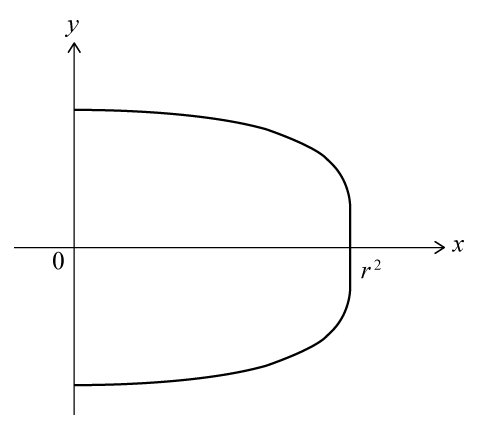
Consider the curve $(x - d)^2 + (y - 2)^2 = 4$ where $x, y \in \mathbb{R}$ and $d > 2$, shown in the following diagram.
Curve diagram
The region enclosed by the curve is rotated through $2\pi$ radians around the $y$-axis to form a solid, $\text{S}$.
(a) Show that the volume of $\text{S}$ is given by $4\pi d \displaystyle\int_0^4 \sqrt{4 - (y - 2)^2}\,\mathrm{d}y\,.$
[6]
It is given that the volume of $\text{S}$ is $50\pi^2\,\text{cm}^3$.
(b) Find the value of $d$.
[2]

Question 8
Calculator Not Allowed
Difficulty: Medium

[Maximum mark: 20]
Consider the family of functions $f_n$ defined by $f_n(x) = \displaystyle\sum_{r=0}^{n} (-2x^2)^r$, where $x \in \mathbb{R}$ and $n \in \mathbb{N}$.
(a) Show that $f_n$ is an even function for all values of $n$.
[3]
(b) (i) Show that $f_3(x) = 1 - 2x^2 + 4x^4 - 8x^6$.
(ii) Write down a similar expression for $f_4(x)$ in ascending powers of $x$.
[2]
Consider the function $f(x) = \displaystyle\lim_{n \to \infty} f_n(x)$ defined over the domain $-k < x 0$. The largest possible value of $k$ is $K$.
(c) (i) Find the value of $K$, giving your answer in exact form.
(ii) Express $f(x)$ as a rational function in the form $\dfrac{1}{a + bx^2}$, where $a$ and $b$ are constants to be determined.
[5]
The function $g$ is defined as $g(x) = f(x)$ for $0 \le x < K$.
(d) (i) Justify that $g^{-1}$ exists.
(ii) Find $g^{-1}(x)$, giving its domain.
[6]
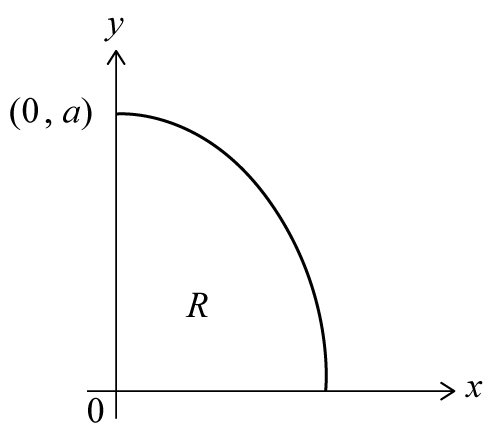
The region $R$ is completely enclosed by the curves $y = g(x)$, $y = g^{-1}(x)$ and the $x$- and $y$-axes, as shown on the following diagram.
Region R enclosed by y = g(x), y = g^-1(x) and axes
(e) Find the area of $R$.
[4]

Question 9
Calculator Not Allowed
Difficulty: MEDIUM

[Maximum mark: 19]
Consider the family of functions $f_n(x) = \cos^n x$, where $x \in \mathbb{R}$ and $n \in \mathbb{N}$.
(a)
By writing $\cos^n x$ as $\cos^{n-1} x \cos x$, show that
$\displaystyle\int \cos^n x\,\mathrm{d}x = \cos^{n-1} x \sin x + (n-1)\displaystyle\int \cos^{n-2} x\,\mathrm{d}x - (n-1)\displaystyle\int \cos^n x\,\mathrm{d}x\text{ for } n > 1$.
[4]
(b) Hence, show that $\displaystyle\int f_n(x)\,\mathrm{d}x = \dfrac{1}{n} \cos^{n-1} x \sin x + \dfrac{n-1}{n}\displaystyle\int f_{n-2}(x)\,\mathrm{d}x\text{ for } n > 1$.
[2]
(c)
Hence, find an expression for $\displaystyle\int \cos^4 x\,\mathrm{d}x$, giving your answer in the form $p\cos^3 x \sin x + q\cos x \sin x + rx + c$ where $p,\, q,\, r \in \mathbb{Q}^+$.
[4]
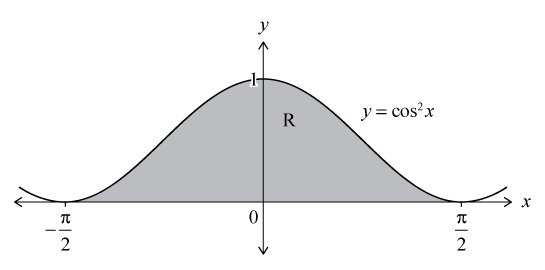
The region $\mathrm{R}$ is enclosed by the graph of $y = \cos^2 x$ and the $x$-axis where $-\dfrac{\pi}{2} \le x \le \dfrac{\pi}{2}$, as shown in the following diagram.
The region $\mathrm{R}$ is rotated by $2\pi$ radians around the $x$-axis to form a solid of revolution.
(d) Find the volume of the solid.
[4]
(e)
(i) Find the Maclaurin series of $f_n(x)$ up to the term in $x^2$.
(ii)
Hence or otherwise, find $\displaystyle\lim_{x \to 0} \dfrac{f_n(x) - 1}{x^2}$ in terms of $n$.
[5]

Question 10
Calculator Not Allowed
Difficulty: Medium

[Maximum mark: 17][cite: 58]
The lengths, in metres, of jumps in a long jump competition can be modelled by a continuous random variable $X$ with probability density function $f$ defined by:[cite: 58]
$f(x) = \begin{cases} 0, & x 9 \end{cases}$[cite: 58]
where $a,\, b \in \mathbb{R},\ a,\, b \neq 0$.[cite: 58]
(a) Show that $324a + 72b = 1$.[cite: 58]
[4][cite: 58]
It is given that $f(9) = 0$.[cite: 58]
(b) (i) Show that $6a + b = 0$.[cite: 58]
(ii) Determine the value of $a$ and the value of $b$.[cite: 58]
[4][cite: 58]
(c) Show that the median of $X$ is less than the mode of $X$.[cite: 58]
[5][cite: 58]
Matt has the final jump in the competition. He needs to jump at least $8.52\,\text{m}$ to win the competition.[cite: 58]
(d) Given that he jumps over $8\,\text{m}$, use the model to find the probability that he wins the competition.[cite: 58]
[4][cite: 58]

Question 11
Calculator Not Allowed
Difficulty: Medium

[Maximum mark: 15]
Consider the function defined by $f(x) = \displaystyle\frac{1}{2}x^2 + kx + 13$, where $x \in \mathbb{R}$ and $k \in \mathbb{Z}^+$.
(a) Given that the equation $f(x) = 0$ has no real roots, show that the greatest possible value of $k$ is $5$.
[2]
For the remainder of this question, consider the case $k = 5$.
(b) (i) Write down the equation of the axis of symmetry of the graph of $f$.
(ii) Hence, or otherwise, determine the coordinates of the minimum point on the graph of $f$.
[3]
The following diagram shows the graph of $f$ and a line $L$ which is normal to the curve at $x = -3$. The shaded area shown is bounded by the curve, the line $L$ and the $y$-axis.
Graph showing f(x), line L, and shaded area
(c) Show that the equation of $L$ is given by $y = -\displaystyle\frac{1}{2}x + 1$.
[5]
(d) Hence, find the shaded area.
[5]

Question 12
Calculator Not Allowed
Difficulty: Easy

[Maximum mark: 7]
Consider the function $f(x) = \sec\left(x - \dfrac{\pi}{4}\right)$, for $0 \le x \le \dfrac{\pi}{2}$.
(a) Determine the range of $f$.
[3]
The region bounded by the graph of $y = f(x)$, the $x$-axis and the lines $x = 0$ and $x = \dfrac{\pi}{2}$ is rotated $2\pi$ radians about the $x$-axis.
(b) Find the volume of revolution generated.
[4]

Question 13
Calculator Not Allowed
Difficulty: Medium

[Maximum mark: 17]
Consider the function $f(x) = \dfrac{-x - 7}{x^2 + 4x + 3}$, where $x \in \mathbb{R},\; x \ne -3,\; x \ne -1$.
(a) Use partial fractions to show that $f(x)$ can be expressed as $\dfrac{2}{3 + x} - \dfrac{3}{1 + x}$.
[3]
(b) Show that the area of the region enclosed by the graph of $y = f(x)$, the $x$-axis and the lines $x = 0$ and $x = 1$ is $\ln\dfrac{9}{2}$.
[5]
(c) Show that the binomial expansion of $f(x)$ up to and including the $x^2$ term is $-\dfrac{7}{3} + \dfrac{25}{9}x - \dfrac{79}{27}x^2$.
[4]
(d)
(i) Use the result from part (c) to find an approximation of $\displaystyle\int_0^1 f(x)\mathrm{d}x$.
(ii) Hence, write down the area enclosed by the $x$-axis, the graph of $y = -\dfrac{7}{3} + \dfrac{25}{9}x - \dfrac{79}{27}x^2$ and the lines $x = 0$ and $x = 1$.
[3]
The value of $\ln\dfrac{9}{2}$ correct to three significant figures is $1.50$.
(e) Determine whether the binomial expansion approximation is an underestimate or an overestimate of the area found in part (b). Justify your answer.
[2]

Question 14
Calculator Allowed
Difficulty: Medium

[Maximum mark: 19]
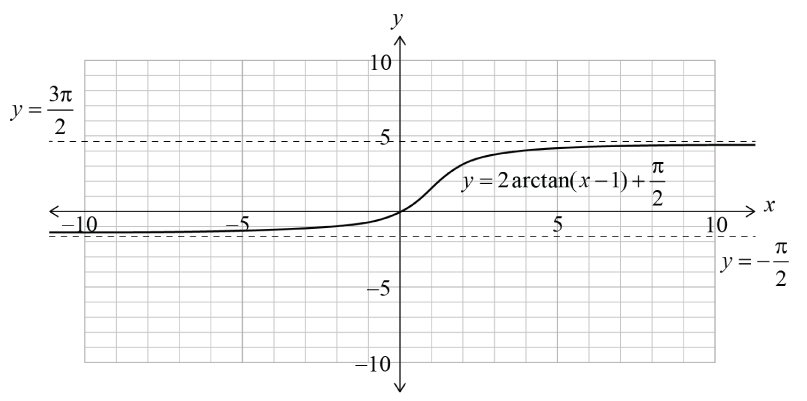
Consider the function $f(x) = 2\arctan(x - 1) + \dfrac{\pi}{2}$ where $x \in \mathbb{R}$.
(a) Sketch the graph of $y = f(x)$, clearly indicating any asymptotes with their equations.
[3]
(b)
(i) Describe a sequence of transformations that transform the graph of $y = \arctan x$ to the graph of $y = 2\arctan(x - 1) + \dfrac{\pi}{2}$ for $x \in \mathbb{R}$.
(ii) Write down the coordinates of the point of inflexion on the graph of $y = f(x)$.
[4]
(c)
(i) Find $f^{-1}(x)$ and state its domain.
(ii) Find the coordinates of the point of intersection of the graphs $y = f(x)$ and $y = f^{-1}(x)$ for $x > 0$.
[6]
(d) Find the equation of the tangent to the graph of $y = f(x)$ at $x = 3$.
[2]
This tangent intersects the graph of $y = f(x)$ at the point $\text{P}$.
(e)
(i) Find the coordinates of $\text{P}$.
(ii) Find the area enclosed by the tangent and the graph of $y = f(x)$.
[4]

Question 15
Calculator Not Allowed
Difficulty: Easy

[Maximum mark: 5][cite: 43]
Consider the function $f(x) = \mathrm{e}^{\frac{3x}{4}}$, where $x \geq 0$.[cite: 43]
The region enclosed by the curve $y = f(x)$, the line $y = 8$ and the $y$-axis is rotated by $2\pi$ radians about the $y$-axis to form a solid. This is shown in the following diagrams.[cite: 43]
x y 8 6 4 2 0 2
Find the volume of the solid formed.[cite: 43]

Question 16
Calculator Allowed
Difficulty: Easy

[Maximum mark: 7]
Consider the function $g$ defined as $g(x) = x^3 - 3x + 2\sin x$, where $x \in \mathbb{R}$.
The graph of $g$ has a local maximum at point $\text{A}$ and a local minimum at point $\text{B}$. The line $(\text{AB})$ passes through the origin $\text{O}$ at $(0,\,0)$.
The region $\text{R}$ is enclosed by the graph of $g$ and the line segment $[\text{OB}]$, as shown on the following diagram.
Diagram showing the graph of g and region R
(a) Find the coordinates of point $\text{A}$ and the coordinates of point $\text{B}$.
[2]
(b) Find the area of $\text{R}$.
[5]

Question 17
Calculator Not Allowed
Difficulty: Easy

[Maximum mark: 7]
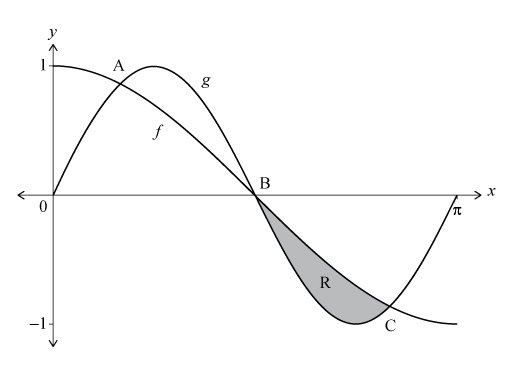
Consider the functions $f(x) = \cos x$ and $g(x) = \sin 2x$, where $0 \le x \le \pi$.
The graph of $f$ intersects the graph of $g$ at the point $\text{A}$, the point $\text{B}\left(\frac{\pi}{2}, 0\right)$ and the point $\text{C}$ as shown on the following diagram.
Graphs of f(x) = cos x and g(x) = sin 2x intersecting at A, B, and C with shaded region R
(a) Find the $x$-coordinate of point $\text{A}$ and the $x$-coordinate of point $\text{C}$.
[3]
The shaded region $\text{R}$ is enclosed by the graph of $f$ and the graph of $g$ between the points $\text{B}$ and $\text{C}$.
(b) Find the area of $\text{R}$.
[4]

Question 18
Calculator Not Allowed
Difficulty: EASY

[Maximum mark: 7]
Consider the functions $f(x) = \cos x$ and $g(x) = \sin 2x$, where $0 \leq x \leq \pi$.
The graph of $f$ intersects the graph of $g$ at the point $\text{A}$, the point $\text{B}\!\left(\displaystyle\frac{\pi}{2}, 0\right)$ and the point $\text{C}$ as shown on the following diagram.
Graphs of f(x) and g(x) showing region R
(a) Find the $x$-coordinate of point $\text{A}$ and the $x$-coordinate of point $\text{C}$.
[3]
The shaded region $\text{R}$ is enclosed by the graph of $f$ and the graph of $g$ between the points $\text{B}$ and $\text{C}$.
(b) Find the area of $\text{R}$.
[4]

Question 19
Calculator Not Allowed
Difficulty: Medium

[Maximum mark: 17]
Consider the polynomial $P(x) = 3x^3 + 5x^2 + x - 1$.
(a) Show that $(x + 1)$ is a factor of $P(x)$.
[2]
(b) Hence, express $P(x)$ as a product of three linear factors.
[3]
Now consider the polynomial $Q(x) = (x + 1)(2x + 1)$.
(c) Express $\frac{1}{Q(x)}$ in the form $\frac{A}{x + 1} + \frac{B}{2x + 1}$, where $A, B \in \mathbb{Z}$.
[3]
(d) Hence, or otherwise, show that $\frac{1}{(x + 1)Q(x)} = \frac{4}{2x + 1} - \frac{2}{x + 1} - \frac{1}{(x + 1)^2}$.
[2]
(e) Hence, find $\displaystyle\int \frac{1}{(x + 1)^2(2x + 1)}\,\text{d}x$.
[4]
Consider the function defined by $f(x) = \frac{P(x)}{(x + 1)Q(x)}$, where $x \ne -1$, $x \ne -\frac{1}{2}$.
(f) Find
(i) $\displaystyle\lim_{x \to -1} f(x)$;
(ii) $\displaystyle\lim_{x \to \infty} f(x)$.
[3]

Question 20
Calculator Not Allowed
Difficulty: MEDIUM

[Maximum mark: 17]
Consider the polynomial $P(x) = 3x^3 + 5x^2 + x - 1$.
(a) Show that $(x + 1)$ is a factor of $P(x)$.
[2]
(b) Hence, express $P(x)$ as a product of three linear factors.
[3]
Now consider the polynomial $Q(x) = (x + 1)(2x + 1)$.
(c) Express $\displaystyle\frac{1}{Q(x)}$ in the form $\displaystyle\frac{A}{x + 1} + \frac{B}{2x + 1}$, where $A, B \in \mathbb{Z}$.
[3]
(d) Hence, or otherwise, show that $\displaystyle\frac{1}{(x + 1)Q(x)} = \frac{4}{2x + 1} - \frac{2}{x + 1} - \frac{1}{(x + 1)^2}$.
[2]
(e) Hence, find $\displaystyle\int \frac{1}{(x + 1)^2(2x + 1)}\,\mathrm{d}x$.
[4]
Consider the function defined by $f(x) = \displaystyle\frac{P(x)}{(x + 1)Q(x)}$, where $x \neq -1$, $x \neq -\displaystyle\frac{1}{2}$.
(f)
Find
(i) $\displaystyle\lim_{x \to -1} f(x)$;
(ii) $\displaystyle\lim_{x \to \infty} f(x)$.
[3]

Question 21
Calculator Not Allowed
Difficulty: Easy

[Maximum mark: 4]
Find the area completely enclosed by the curves $y = \text{e}^x$, $y = -\text{e}^x$, and the lines $x = -1$ and $x = 1$.

Question 22
Calculator Not Allowed
Difficulty: Easy

[Maximum mark: 5]
Let $y = x^4 - \sin 4x$.
(a) Find $\displaystyle\frac{\mathrm{d}y}{\mathrm{d}x}$.
[2]
(b) Hence, or otherwise, find $\displaystyle\int (x^4 - \sin 4x)^7 (x^3 - \cos 4x)\,\mathrm{d}x$.
[3]

Question 23
Calculator Allowed
Difficulty: Easy

[Maximum mark: 5]
Part of the curve of $y = \dfrac{20}{x + 1}$ between point $\text{A}(1,\, 10)$ and point $\text{B}(4,\, 4)$ is rotated $360^\circ$ about the $y$-axis to form a solid of revolution.
Find the volume of the solid formed.

Question 24
Calculator Not Allowed
Difficulty: Medium

[Maximum mark: 22]
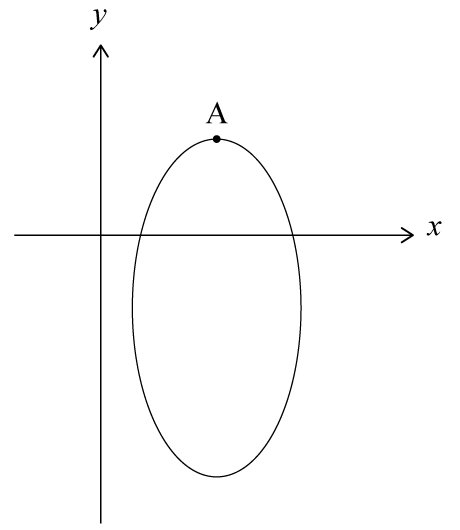
The curve $C$ has equation $4x^2 + y^2 - 24x + 4y + 20 = 0$.
The following diagram shows $C$ with a maximum point at $\text{A}$.
Curve C with maximum point A
(a) Use implicit differentiation to show that $\dfrac{\mathrm{d}y}{\mathrm{d}x} = \dfrac{4(3-x)}{y+2}$.
[4]
(b) Hence, determine the domain of $C$. Give your answer in the form $3 - \sqrt{a} \le x \le 3 + \sqrt{a}$, where $a \in \mathbb{Z}^+$.
[4]
(c) Find $(x_{\text{A}},\ y_{\text{A}})$, the coordinates of $\text{A}$.
[3]
A line $y = mx$ is a tangent to $C$, where $m \in \mathbb{Z}$.
(d) Find the possible values of $m$.
[4]
The line $y = -4x$ touches $C$ at point $\text{B}$.
(e) Find $y_{\text{B}}$, the $y$-coordinate of $\text{B}$.
[3]
The region bounded by the curve $C$, the $y$-axis and the lines $y = y_{\text{A}}$ and $y = y_{\text{B}}$, is rotated $360^\circ$ about the $y$-axis to form a solid of revolution.
(f) Find the volume of this solid of revolution.
[4]