(a)
attempt to use the recursive formula $y_n = y_{n-1} + 0.01\left(y_{n-1}^3 – \dfrac{y_{n-1}}{x_{n-1}}\right)$
(M1)
| n |
$x_n$ |
$y_n$ |
| 0 |
1 |
2 |
| 1 |
1.01 |
2.06 |
| 2 |
1.02 |
$2.12702\ldots$ |
| 3 |
1.03 |
$2.20240\ldots$ |
| 4 |
1.04 |
$2.28784\ldots$ |
| 5 |
1.05 |
$2.38559\ldots$ |
$y_1 = 2.06$
(A1)
$y_5 = 2.39$
A1
[3 marks]
(b)
attempt to use implicit differentiation with respect to $x$
(M1)
$-\dfrac{2}{y^3}\dfrac{\text{d}y}{\text{d}x} = -2\dfrac{\text{d}z}{\text{d}x} \quad\text{OR}\quad \dfrac{\text{d}y}{\text{d}x} = y^3\dfrac{\text{d}z}{\text{d}x} \quad\text{(accept equivalent)}$
A1
substitute $\dfrac{\text{d}y}{\text{d}x}\text{ and } y^2 = -\dfrac{1}{2z}\text{ into their derivative}$
(M1)
$-\dfrac{2}{y^3}\left(y^3 – \dfrac{y}{x}\right) = -2\dfrac{\text{d}z}{\text{d}x} \quad\text{OR}\quad y^3 – \dfrac{y}{x} = y^3\dfrac{\text{d}z}{\text{d}x}$
$1 – \dfrac{1}{xy^2} = \dfrac{\text{d}z}{\text{d}x}$
A1
$\dfrac{\text{d}z}{\text{d}x} – \dfrac{2z}{x} = 1$
AG
[4 marks]
(c)
METHOD 1
attempt to find integrating factor
M1
$I(x) = \text{e}^{\int -\frac{2}{x}\,\text{d}x} = \text{e}^{-2\ln(x)}$
$I(x) = \dfrac{1}{x^2}$
A1
$\dfrac{1}{x^2}\dfrac{\text{d}z}{\text{d}x} – \dfrac{2z}{x^3} = \dfrac{1}{x^2}$
$\dfrac{z}{x^2} = \displaystyle\int \dfrac{1}{x^2}\,\text{d}x$
A1
$\dfrac{z}{x^2} = -\dfrac{1}{x}\ (+c)$
A1
attempt to substitute $x = 1,\, z = -\dfrac{1}{2(2)^2}\text{ (or } y = 2\text{) into their integral to find } c$
(M1)
$c = \dfrac{7}{8}$
substitute $z = -\dfrac{1}{2y^2}\text{ (seen anywhere)}$
(M1)
$-\dfrac{1}{2y^2 x^2} = -\dfrac{1}{x} + \dfrac{7}{8}$
$\dfrac{1}{2y^2 x^2} = \dfrac{8 – 7x}{8x}$
$y = \sqrt{\dfrac{4}{x(8 – 7x)}}\text{ or equivalent}$
A1
METHOD 2
attempt to use the substitution $z = vx\text{ and } \dfrac{\text{d}z}{\text{d}x} = \dfrac{\text{d}v}{\text{d}x}x + v\text{ to reduce to a separable equation}$
M1
$\dfrac{\text{d}v}{\text{d}x}x + v – 2v = 1$
$\dfrac{\text{d}v}{\text{d}x}x = 1 + v$
A1
$\displaystyle\int \dfrac{1}{1 + v}\,\text{d}v = \int \dfrac{1}{x}\,\text{d}x$
A1
$\ln|1 + v| = \ln|x| (+ c) \quad\text{OR}\quad \ln\left|1 + \dfrac{z}{x}\right| = \ln|x| (+ c)$
A1
attempt to substitute $x = 1,\, z = -\dfrac{1}{2(2)^2}\text{ (or } y = 2\text{) into their integral to find } c$
(M1)
$c = \ln\left(\dfrac{7}{8}\right)$
substitute $z = -\dfrac{1}{2y^2}\text{ (seen anywhere)}$
(M1)
$\ln\left|1 – \dfrac{1}{2y^2 x}\right| = \ln\left(\dfrac{7}{8}x\right)$
$1 – \dfrac{1}{2y^2 x} = \dfrac{7}{8}x$
$\dfrac{1}{y^2} = 2x\left(1 – \dfrac{7}{8}x\right)$
$y = \sqrt{\dfrac{4}{x(8 – 7x)}}\text{ or equivalent}$
A1
[7 marks]
(d)
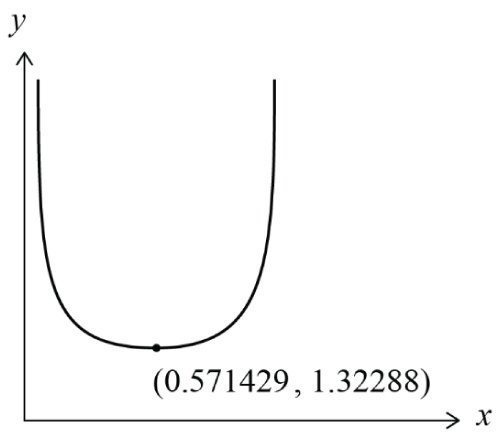
recognizing denominator is zero OR denominator cannot be zero
OR attempt to sketch the graph of $y = \sqrt{\dfrac{4}{x(8 – 7x)}}$
(M1)
$\dfrac{8}{7} \quad\text{OR}$
$(\text{domain}) \quad 0 < x < \dfrac{8}{7} \quad\text{OR}\quad x \in \left]0,\, \dfrac{8}{7}\right[$
A1
$1.32288\ldots$
$(\text{range}) \quad y \ge 1.32 \quad\text{OR}\quad f(x) \ge 1.32 \quad\text{OR}\quad f(x) \in [1.32,\, \infty[$
A1
allow exact value of $\dfrac{\sqrt{7}}{2}$ in place of $1.32$.
Note: The A1 marks can be awarded independently.
[3 marks]
(e)
underestimates $\left(\text{when } y = \sqrt{\dfrac{4}{x(8 – 7x)}}\right)$ as it is concave-up
R1
Note: Award R0 if candidate only states ‘underestimates’ without reference to concavity.
[1 mark]
Total [18 marks]